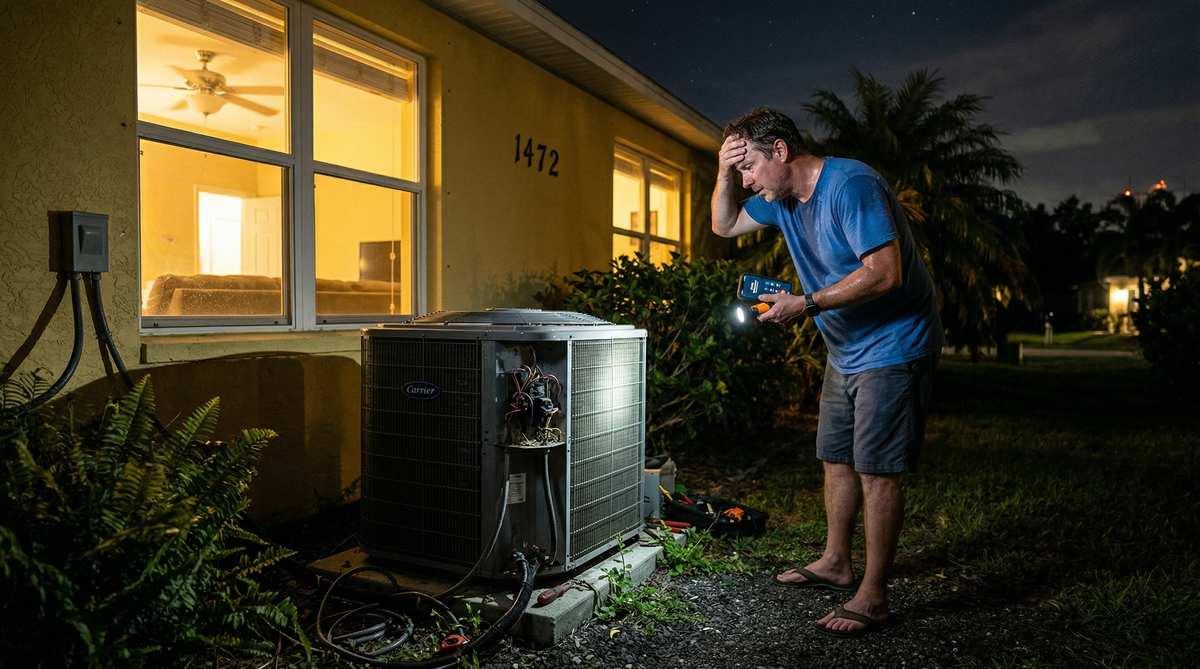
Quick Answer
If your AC stops working in Florida, turn off the system to avoid further damage, then run through the quick self-checks below (thermostat, breaker, filter, drain). In summer heat, a non-functioning AC can create dangerous conditions within hours for children, elderly family members, and pets. Close blinds on sun-facing windows, use portable fans to circulate air, and move to the lowest floor. Then call Top Notch Air Conditioning & Heating at (863) 875-5500, open Mon–Sat 8 AM–5 PM. If it’s after hours, call first thing the next business day.
Your AC has stopped working, and Polk County summers don’t wait. Whether it happened during the day or while you slept, the process is the same: take a few self-check steps that can resolve the problem without a service call, protect your household from the heat, then call a licensed technician at the first opportunity.
Air conditioning failure in Florida is a genuine safety concern, particularly for households with young children, elderly family members, people with respiratory conditions, or pets. Indoor temperatures in a closed, non-air-conditioned Florida home can reach dangerous levels within hours during summer peak periods.
This guide walks you through exactly what to do, step by step, when your AC stops working in Polk County.
Step 1: Check the Obvious Causes First
Before calling for service, run through these quick checks. A significant percentage of HVAC calls are resolved by these simple diagnostics:
| Check This | How to Check | What to Do If Found |
|---|---|---|
| Circuit breaker | Check breaker panel for tripped breaker | Reset once, if it trips again, call for service |
| Thermostat batteries | Screen blank or dim? | Replace batteries, reset to cooling mode |
| Thermostat settings | Is it set to Cool and below current temp? | Correct settings; wait 5 min for system to start |
| Float switch shutoff | Check near air handler for clogged condensate pan | Clear drain line, system should restart |
| Air filter | Is it completely clogged? | Replace filter, this can cause system shutdown |
| Outdoor unit running | Go outside, is the condenser fan spinning? | If not running, check breaker for outdoor disconnect |
Step 2: Call Top Notch Air Conditioning & Heating
If the quick checks above do not resolve the problem, call (863) 875-5500. We serve all of Polk County: Winter Haven, Lakeland, Bartow, Haines City, Auburndale, Plant City, Mulberry, Davenport, Inwood, and Wahneta. Our business hours are Mon–Sat 8 AM–5 PM. If your system went down after hours, turn it off, follow the safety steps in Step 3, and call us first thing the next morning. Yeti Club members receive priority scheduling.
When you call, have this information ready: your complete address, the brand and approximate age of your system, what the system is doing or not doing, when the problem started, the current indoor temperature, and whether anyone in the household has medical vulnerabilities.
Step 3: Make Your Home as Safe as Possible While Waiting
While waiting for the technician, take these steps to slow the rate of indoor temperature rise:
- Close all blinds, curtains, and shades: Especially on east, west, and south-facing windows. This alone can significantly slow heat gain.
- Close interior doors: Limit the space you need to keep cool to the rooms you are actually using.
- Turn off heat-generating devices: Incandescent lights, televisions, computers, and other electronics all generate heat. Switch off anything that is not essential.
- Move to the lowest floor: Heat rises, so lower floors are always cooler than upper floors during a system failure.
- Use portable fans: Position fans to create airflow across your body rather than just moving air around. A fan combined with a damp cloth on your neck significantly improves comfort through evaporative cooling.
Step 4: Know When to Leave
If indoor temperatures exceed 85 degrees and continue rising, particularly with vulnerable household members present, consider a hotel. Most Polk County hotels accommodate same-night last-minute bookings. You can also go to an air-conditioned space such as a library, retail store, or grocery store, or call neighbors or family members who may have space for temporary shelter.
What Should You Expect When a Technician Arrives?
When a Top Notch Air Conditioning & Heating technician arrives at your home, the process involves diagnosis by running a systematic check of electrical components, refrigerant pressure, compressor operation, and controls. Before any repair, we provide a written estimate with clear parts and labor costs. Common same-day repairs include failed capacitors, failed contactors, tripped pressure switches, clogged condensate drains, and some refrigerant issues. We stock the most common repair parts on every service vehicle. When repair requires parts not on the truck, such as with compressor failures or refrigerant coil leaks, the technician will advise on next steps and timeline.
What Do AC Repairs Cost in Polk County?
Pricing varies by system size, home size, and installation complexity.
Call (863) 875-5500 for a free in-home estimate. Every job is priced individually.
Top Notch Air Conditioning & Heating provides all pricing upfront. You will know the cost before we begin any repair work.
How Do You Prevent AC Failures Before They Happen?
Most AC failures are almost always preceded by warning signs that were either missed or dismissed. Schedule a spring tune-up before cooling season. Capacitors, contactors, and refrigerant issues are typically caught during professional maintenance before they become failures. Replace air filters monthly. Clogged filters are the most preventable cause of system failures. Listen for new sounds. A clicking that was not there before is often a capacitor failing. A buzzing contactor relay or screeching bearings, caught early, are inexpensive repairs. Monitor your electric bills. A system that is drawing more power is working harder to compensate for a developing problem.
When Repair Is Not the Right Answer
When your AC fails unexpectedly, the pressure to make fast decisions can lead to poor outcomes. Here is a framework for thinking clearly about the repair versus replace decision:
- Simple component failures on newer systems: Capacitor, contactor, thermostat, float switch, and drain line issues on systems under 10 years old are always worth repairing. These are predictable maintenance items, not signs of system-wide failure.
- Compressor failure on an older system: If your system is 10 years or older and the compressor has failed, the situation should not rush you into an expensive compressor repair. A licensed technician can advise on options and give you time to consider replacement versus repair with a clear head.
- Refrigerant leak: If a refrigerant leak is diagnosed, the system can be temporarily charged to restore cooling while a permanent repair or replacement is planned. This is a legitimate interim measure that avoids a rushed major decision.
- Systems using R-22 refrigerant: Any system manufactured before approximately 2010 that needs refrigerant is a strong replacement candidate regardless of the hour. R-22 refrigerant is increasingly difficult to source and costly. A recharge on an older R-22 system is money spent on equipment that should be replaced, call (863) 875-5500 to discuss your options.
Our technicians are trained to give you an honest assessment, not to pressure you into the most expensive option. If a service call reveals that your system is a strong replacement candidate, we will tell you that clearly, along with your options for getting through the situation comfortably.
Frequently Asked Questions
What are Top Notch Air Conditioning & Heating’s service hours?
Top Notch Air Conditioning & Heating is open Mon–Sat 8 AM–5 PM, closed Sundays. If your system stops working after hours, turn it off, follow the safety steps in this guide, and call (863) 875-5500 first thing the next business day. Yeti Club members receive priority scheduling, meaning we fit them in as early as possible during business hours.
Is it safe to run my AC if it is making a new noise?
It depends on the noise. A mild new hum or click is generally safe to operate while awaiting a service appointment. A loud banging, screeching, or grinding sound warrants shutting the system off and calling immediately, continuing to run a system with these symptoms can turn a minor repair into a major compressor replacement.
What is the most common reason ACs fail unexpectedly?
Capacitor failure is the single most common AC repair in Florida, and it often happens on the hottest days when the system is working hardest. Capacitors are electrical components that help start and run the compressor and fan motors. They degrade gradually from heat cycling and typically fail completely during peak demand. They are inexpensive to replace and almost always something a professional tune-up would catch before failure.
Should I try to add refrigerant myself?
No. Refrigerant handling requires EPA Section 608 certification, it is illegal for uncertified individuals to purchase or handle refrigerants. Additionally, adding refrigerant to a system without finding and fixing the leak is a temporary measure at best. A qualified technician will locate the leak, repair it, and then recharge the system to the correct specification.
How can I prevent my AC from failing during a Florida summer?
The most effective prevention is a spring tune-up with a qualified technician, performed in February or March before summer demand peaks. This gives the technician time to identify and replace components showing wear before they fail under summer load. Monthly filter changes and condensate drain treatment also prevent the two most common Florida-specific system problems.
Conclusion
When your AC stops working in a Florida summer, a little preparation makes a big difference. Knowing in advance what to check, when to call, and how to keep your household safe turns a stressful situation into a manageable one. If you are reading this while your system is working fine, now is the right time to schedule a maintenance check and make sure a borderline capacitor doesn’t catch you off-guard. Save our number: (863) 875-5500, Mon–Sat 8 AM–5 PM.