Quick Answer
The most urgent warning signs that your AC needs repair before summer are: warm air blowing from vents, unusual noises such as grinding or banging, rising electric bills without usage changes, frequent cycling on and off, and visible ice on refrigerant lines or the indoor unit. Catching these early in March or April means faster service, lower repair costs, and a working system when temperatures peak in June.
Every summer in Polk County follows a predictable pattern: temperatures climb into the mid-90s, humidity makes the heat index feel like 105 degrees, and HVAC companies across the region get flooded with repair calls from homeowners whose systems just quit. Many of those failures were preventable. The warning signs were there weeks or months earlier, but without knowing what to look for, most people do not notice until the system stops cooling entirely.
This guide covers the 10 most common and significant warning signs that your AC needs attention before summer arrives. These are patterns our technicians Oscar, Craig, Josh, and Nelson see repeatedly on service calls throughout Winter Haven Lakeland Bartow, and surrounding Polk County communities.
Sign 1: Warm or Lukewarm Air From the Vents
This is the most obvious sign, but homeowners often dismiss it as the system just taking time to cool down. In reality, a properly functioning AC should begin blowing noticeably cold air within a few minutes of startup. If your vents are delivering air that feels only slightly cooler than room temperature, you likely have one of the following problems:
- Low refrigerant charge due to a slow leak in the coils or refrigerant lines
- A failing or failed compressor that is not properly compressing refrigerant
- A dirty evaporator coil that cannot absorb heat effectively
- Incorrect thermostat settings, which is worth checking first
Sign 2: Grinding, Banging, or Screeching Sounds
Your AC should operate with a consistent, relatively quiet hum. Any sound that is new or unusual warrants attention. Here is what common sounds typically indicate:
| Sound | Likely Cause | Urgency Level |
|---|---|---|
| Grinding (air handler) | Failing blower motor bearings | High, repair soon |
| Banging (outdoor unit) | Loose or broken compressor mount | High, shut off system |
| Screeching or squealing | Belt or fan blade contact | Medium, schedule within days |
| Clicking at startup | Failing capacitor or contactor relay | Medium-High, schedule soon |
| Hissing near indoor unit | Refrigerant leak | High, call for service |
| Rattling (outdoor unit) | Loose panels or debris in fan | Low, inspect and schedule |
Sign 3: Electric Bills Climbing Without Reason
Florida Power and Light customers in Polk County know that summer electricity bills are high, but there is a difference between expected seasonal increases and abnormal spikes. If your June electric bill is 25 to 40% higher than it was in June the previous year without a change in usage, your AC is almost certainly losing efficiency. Compare the same month across two or three years for an accurate picture. A system that is low on refrigerant, has a dirty coil, or is losing compressor efficiency can consume 20 to 40% more electricity to achieve the same cooling output.
Sign 4: Short-Cycling (Constant On-Off)
Short-cycling means your system starts and stops repeatedly, completing short run cycles of 5 minutes or less rather than the normal 15 to 20 minute cooling cycles. This is hard on the compressor, which draws a surge of amperage at every startup, and results in poor humidity control. Short-cycling is caused by:
- Oversized equipment, common after improper installations
- Low refrigerant charge
- Frozen evaporator coil restricting airflow
- Failing thermostat sending incorrect signals
- Faulty high-pressure or low-pressure limit switches
Sign 5: Ice on the Refrigerant Lines or Indoor Unit
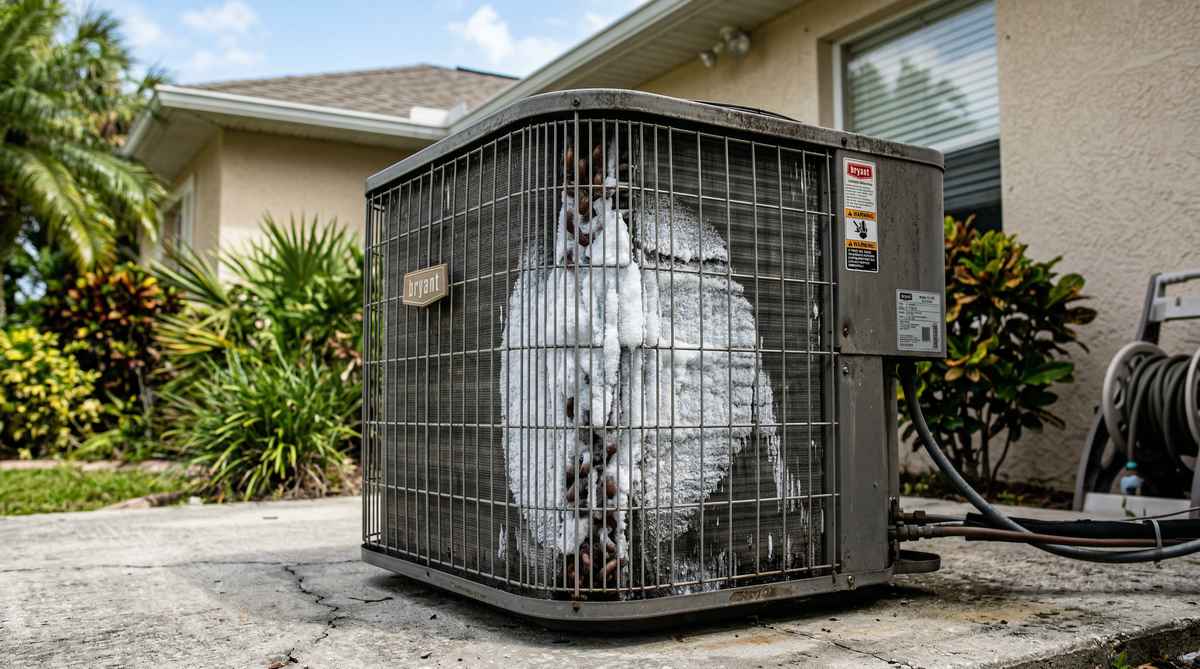
Despite Florida's heat, ice formation on your AC is not a sign that it is working extra hard. It is a sign of a serious problem. Ice on the copper refrigerant lines near the air handler, or on the evaporator coil itself, indicates severely restricted airflow from a clogged filter or dirty coil, or critically low refrigerant. When you see ice, turn the system off immediately and let it thaw. Then call for service before running the system again. Continued operation while frozen can damage the compressor.
Sign 6: Water Pooling Around the Indoor Unit
Florida's humidity means your AC's evaporator coil is constantly removing water from the air. That condensate needs to drain through the drain line to a floor drain or outside. When the drain line clogs, which happens very commonly in Florida due to algae growth in warm, humid conditions, water backs up and overflows the drain pan. Minor overflows cause damage to drywall, ceilings, and flooring. Major overflows cause mold. This is one of the most preventable HVAC problems in Florida and one of the most common reasons for service calls in Polk County.
Sign 7: High Indoor Humidity
If your home feels sticky or muggy even when the AC is running and the temperature is at setpoint, your system has a humidity problem. A properly sized and functioning AC removes both heat and moisture. Common causes of poor dehumidification include oversized equipment that cools too quickly without running long enough to pull moisture, low refrigerant causing the evaporator coil to run warmer than designed, and duct leaks bringing in unconditioned humid air from the attic. In Polk County's climate, indoor humidity above 60% creates conditions for mold growth within 24 to 48 hours.
Sign 8: Visible Mold or Musty Odors
A musty smell when the AC runs is often the first sign of mold growth on the evaporator coil or in the ductwork. Mold in HVAC systems is a health issue, not just a comfort issue. It distributes mold spores throughout every room in the house every time the system runs. If you notice a musty or earthy smell from your vents, especially when first starting the system, call for service. A coil cleaning and UV light installation can eliminate the problem and prevent recurrence.
Sign 9: Thermostat Communication Problems
If your thermostat displays incorrect temperatures, fails to respond to changes, or shows error codes, the thermostat itself may be failing, or there may be a communication problem between the thermostat and the air handler. Modern smart thermostats like the Ecobee or Nest can often provide diagnostic information directly on screen. If you have an older programmable thermostat and notice erratic behavior, a thermostat replacement is worth ruling out before more costly repairs.
Sign 10: Your System Is Over 12 Years Old and Has Never Been Serviced
Age alone is not a reason to replace a working system, but an aging system that has never received professional maintenance is a ticking clock. Capacitors degrade and fail silently. Refrigerant develops slow leaks that gradually worsen. Drain lines grow algae. Coils accumulate years of dust and debris that reduce airflow. A professional inspection on an older unmaintained system will almost always uncover multiple issues that, if left unaddressed, will result in failure during peak summer demand.
What Should You Do If You Notice These Signs?
The right approach depends on severity. For ice formation or complete cooling failure, turn the system off and call immediately. For warm air, unusual sounds, or rising bills schedule service within the next week or two rather than waiting until summer. The best outcomes come from catching problems in spring, when scheduling is easier and you are not making decisions under the pressure of a 95-degree day.
Frequently Asked Questions
How much does an AC repair typically cost in Polk County?
Repair costs vary depending on the component and the specific issue. Top Notch Air Conditioning & Heating provides upfront written estimates before any repair work begins, call (863) 875-5500 for current pricing.
Should I turn off my AC if I notice ice on the lines?
Yes. Turn the system to off at the thermostat or switch to fan-only mode to help it thaw faster, and call for service. Running a frozen system risks compressor damage. The first thing to check is whether your air filter is severely clogged, a completely blocked filter can cause freezing. Replace the filter, let the system thaw for 2 to 4 hours, and see if the issue resolves. If it recurs, you have a refrigerant problem that requires a technician.
Is warm air always a sign of low refrigerant?
Not always. Warm air from the vents is also caused by a very dirty air filter, a failing compressor, dirty evaporator coil, or incorrect thermostat settings. Check your filter and thermostat settings first. If both are correct and you still have warm air, you need a technician to diagnose the specific cause.
How long does an AC repair appointment take?
Most diagnostic visits and common repairs such as capacitor, contactor, drain cleaning, and thermostat take 1 to 2 hours. More complex repairs requiring parts that need to be ordered, or compressor replacements, may require a follow-up appointment. Top Notch Air Conditioning & Heating carries the most common repair parts on service vehicles to resolve most issues same-day.
What areas does Top Notch Air Conditioning & Heating serve for AC repair?
We serve all of Polk County, including Winter Haven, Lakeland, Bartow, Haines City, Auburndale, Plant City, Mulberry, Davenport, Inwood, and Wahneta. We offer same-day service throughout our service area, Mon–Sat 8 AM–5 PM.
Conclusion
The 10 warning signs above are your AC's way of communicating that something is wrong before it fails completely. Catching them in spring, when scheduling is still flexible and summer heat has not arrived, is the difference between a manageable repair and a costly breakdown in the middle of July. If your system shows any of these symptoms, do not wait. Call Top Notch Air Conditioning & Heating for a diagnostic and get ahead of the summer rush.