Quick Answer
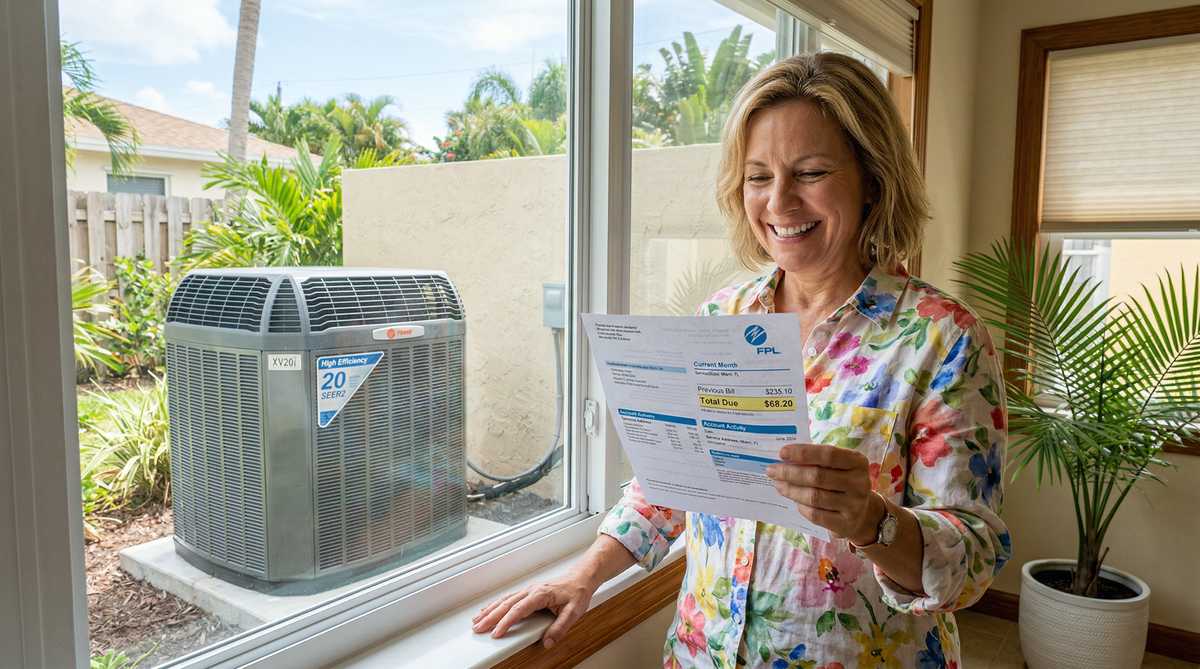
Replacing a 10-year-old 10 to 12 SEER system with a modern 18 SEER2 unit typically reduces cooling costs by 35 to 45% in Florida. For a Polk County home spending $200 to $250 per month on cooling, that is $70 to $112 in monthly savings, or $840 to $1,344 per year. At those savings rates, the higher cost of an efficient system often pays back within 3 to 5 years beyond the cost of an entry-level replacement.
Florida Power and Light customers in Polk County know that the summer electric bill is the unavoidable price of living in Central Florida. Cooling a home here is genuinely expensive, the system runs more hours, against higher temperatures, than in almost any other region of the country. But many Polk County homeowners are paying significantly more than they need to because of aging, inefficient equipment.
This guide explains exactly how AC efficiency affects your monthly bill, how to calculate your potential savings, and what to look for when choosing a system for maximum energy efficiency in Florida's specific conditions.
Understanding SEER2: The Efficiency Rating That Matters
SEER2 (Seasonal Energy Efficiency Ratio 2) is the federally mandated efficiency measurement for air conditioners, updated in 2023 to reflect more realistic operating conditions. The higher the SEER2 rating, the less electricity the system uses to deliver the same amount of cooling. Think of it like gas mileage on a car: a 20 SEER2 system is more fuel efficient than a 14 SEER2 system. And just as a fuel-efficient car saves more money for high-mileage drivers, a high-SEER2 AC saves more money for Florida homeowners who run their systems more hours than almost anywhere else.
| SEER2 Rating | Relative Efficiency | Annual Cooling Cost (3-ton, FL avg) | Annual Savings vs 14 SEER2 |
|---|---|---|---|
| 14.3 SEER2 (minimum) | Baseline | $1,800 to $2,200 | None |
| 16 SEER2 | 12% more efficient | $1,580 to $1,940 | $220 to $260 per year |
| 18 SEER2 | 26% more efficient | $1,330 to $1,630 | $470 to $570 per year |
| 20 SEER2 | 40% more efficient | $1,080 to $1,320 | $720 to $880 per year |
| 24 SEER2 | 68% more efficient | $1,070 to $1,310 | $730 to $900 per year |
Comparing Your Old System to Modern Efficiency
The efficiency gains from replacing aging Florida AC systems can be dramatic because many older systems were manufactured before significant improvements in compressor technology:
| System Age | Typical Original SEER | SEER2 Equivalent | Savings vs New 18 SEER2 |
|---|---|---|---|
| 2000 to 2005 | 9 to 10 SEER | About 8.5 to 9.5 SEER2 | 50 to 55% savings |
| 2006 to 2010 | 11 to 12 SEER | About 10.5 to 11.5 SEER2 | 40 to 50% savings |
| 2011 to 2015 | 13 to 14 SEER | About 12 to 13 SEER2 | 25 to 35% savings |
| 2016 to 2022 | 14 to 16 SEER | About 13 to 15 SEER2 | 15 to 25% savings |
Variable-Speed Technology: Why It Matters More in Florida
The biggest efficiency leap in modern AC systems is not just the raw SEER2 number, it is variable-speed compressor technology. Traditional single-stage compressors operate at 100% capacity or off. Variable-speed compressors operate anywhere from 40% to 100% of capacity, continuously adjusting to match the exact cooling demand.
In Florida's climate, variable-speed systems provide three distinct advantages: better dehumidification because running at low speed for longer cycles removes significantly more moisture, lower electricity consumption because the compressor draws much less power at low speeds, and quieter operation because at low speed variable-speed systems are nearly inaudible inside the home.
FPL Rebates for High-Efficiency Systems
Florida Power and Light offers rebates to Polk County customers who install qualifying high-efficiency HVAC equipment through the FPL energy efficiency programs. Current rebate amounts vary based on efficiency level and equipment type. Confirm current rebate amounts with FPL or your HVAC contractor before purchasing, as programs change periodically. Carrier systems at 18 SEER2 and above frequently qualify for FPL rebates. As a Carrier Factory Authorized Dealer, Top Notch Air Conditioning & Heating can help verify rebate eligibility for any system we install.
Smart Thermostat Savings
A smart thermostat like the Ecobee or Google Nest will not make your existing system more efficient, but it will optimize when and how long it runs, which can reduce cooling costs by 10 to 15% without any change to the equipment itself. For maximum savings, set your thermostat to 78 to 80 degrees when away and 76 to 78 degrees when home. Each degree below 78 degrees increases cooling costs by approximately 4 to 8% in Florida's climate.
Other Factors That Affect Your Cooling Costs
A new efficient AC system is the biggest lever for reducing cooling costs, but these factors also play meaningful roles:
- Attic insulation: Polk County homes with less than R-30 attic insulation are losing significant cooling capacity. Adding insulation to R-38 or R-49 can reduce cooling loads by 15 to 25%.
- Duct sealing: Leaking ductwork in the attic can waste 20 to 30% of your cooling capacity before it reaches the living space.
- Window films and solar shades: Low-E window film on west and south-facing windows can reduce solar heat gain by 30 to 50% without requiring window replacement.
- Regular maintenance: A dirty coil or clogged filter can reduce system efficiency by 15 to 25%. Regular maintenance keeps your system operating at rated efficiency.
The Payback Calculation
Here is a realistic payback example for a Polk County home: a 10-year-old 12 SEER unit with an annual cooling cost of approximately $2,100. An entry-level 14.3 SEER2 replacement brings annual cooling cost to $1,680, a 20% savings of $420 per year. A mid-efficiency 18 SEER2 replacement brings annual cooling cost to $1,260, a 40% savings of $840 per year. The payback on the efficiency upgrade is typically within a few years, call (863) 875-5500 for a free estimate and we will show you the numbers for your specific home.
Combining Efficiency Upgrades: A Whole-Home Strategy
The most effective approach to reducing your cooling costs in Polk County is not a single upgrade but a coordinated strategy. Each measure below compounds on the others:
- Start with the AC system: This is the highest-impact single investment. A new 18 SEER2 variable-speed system is the foundation.
- Add attic insulation: If your attic insulation is below R-30, bringing it to R-38 reduces the heat gain your system must overcome. This can be done at the same time as AC replacement or separately.
- Seal the ducts: If your ducts are in the attic and more than 10 years old, duct sealing or encapsulation pays significant dividends. Reducing duct losses from 25% to 10% is equivalent to upgrading system efficiency by several SEER2 points.
- Add a smart thermostat: A modest investment that can reduce runtime by 10 to 15% through schedule optimization and occupancy detection.
- Address window heat gain: Window film on west and south-facing glass is a low-cost way to reduce the solar load the AC must handle, particularly effective in Florida's long afternoon sun exposures.
Homeowners who combine a high-efficiency AC replacement with attic insulation improvements and duct sealing routinely see total cooling cost reductions of 40 to 60% compared to their previous aging system. That level of savings can make even a premium efficiency system financially compelling within a few years.
Frequently Asked Questions
How much can a new AC reduce my FPL bill?
Savings depend on the efficiency of your old system. Replacing a 10 SEER system with an 18 SEER2 model can reduce cooling costs by 45 to 55%. Replacing a 14 SEER system with 18 SEER2 saves approximately 25 to 30%. For a typical Polk County home spending $200 per month on cooling, this translates to $50 to $110 in monthly savings on an 18 SEER2 replacement.
Are there federal tax credits for energy-efficient AC in 2026?
The Inflation Reduction Act provides a tax credit of up to $600 for qualifying central AC systems and up to $2,000 for qualifying heat pumps. The credit is 30% of the installed cost up to these caps, and the specific efficiency thresholds required change annually. Confirm current eligibility requirements with your tax advisor or the IRS Energy Star website at the time of purchase.
Does a higher SEER2 system cost more to maintain?
Not significantly. High-efficiency systems with variable-speed technology have more sophisticated electronics but the maintenance requirements are similar to standard systems. Routine maintenance costs including filter changes, drain line treatment, and biannual tune-ups are the same regardless of efficiency level.
Is 24 SEER2 worth the extra cost in Florida?
For most Polk County homeowners, 18 to 20 SEER2 hits the best efficiency payback sweet spot. Going from 18 to 24 SEER2 adds significant equipment cost but the incremental savings above 18 SEER2 are smaller. However, if you plan to stay in the home long-term, have a very large home with high cooling costs, or prioritize quiet operation and maximum comfort, the premium may be justified.
Can Top Notch Air Conditioning & Heating help me finance a high-efficiency system?
Yes. We offer 0% interest financing through Wisetack on approved credit, with terms up to 60 months and financing available up to $25,000. The monthly energy savings from a high-efficiency system can offset a meaningful portion of the monthly financing payment, making the upgrade affordable from day one.
Conclusion
For Polk County homeowners with aging equipment, replacing an inefficient system is not just about comfort, it is a financial decision with a measurable return. The combination of Florida's long cooling season, current electricity rates, and modern variable-speed technology makes high-efficiency AC one of the best home improvement investments available. If you would like help calculating the specific savings potential for your home, call Top Notch Air Conditioning & Heating for a free consultation. We will show you the numbers before you decide.