Quick Answer
Ductless mini-splits are ideal for Florida room additions, sunrooms, converted garages, and detached structures because they require no ductwork, install quickly, and provide precise zone control. In Florida's climate, they are also significantly more efficient than extending an existing duct system into a new space. Call (863) 875-5500 for a free estimate on installation in Polk County.
If you have added a room to your home, converted a garage into living space, enclosed a back porch into a Florida room, or built a workshop or home office in a detached structure, you already know the problem: these spaces are hot. Brutally hot by Florida standards. Extending your central AC ductwork into new additions is sometimes possible, but it is expensive, it often requires resizing your central system, and in many cases it is impractical because of the structure or layout of the new space.
Ductless mini-split systems solve this problem elegantly. They are becoming increasingly common throughout Polk County for exactly these applications, and the technology has improved significantly over the past decade in both efficiency and quiet operation. Here is everything you need to know.
How Ductless Mini-Splits Work
A mini-split system consists of two main components: an outdoor condenser unit similar to a traditional AC condenser but smaller, and one or more indoor air handler units that mount on the wall or ceiling inside the conditioned space. The two units are connected by a small refrigerant line set, typically routed through a 3-inch hole in the wall, and an electrical connection.
Unlike central AC, there are no ducts. The indoor unit draws room air across a refrigerant coil, cools or heats it, and returns it to the space directly. This is more efficient than central systems for two reasons: there are no duct losses (central AC loses 20 to 30% of its cooling capacity to heat gain in hot Florida attics), and the system can be targeted precisely at the space that needs conditioning.
Why Are Mini-Splits Especially Suited to Florida Additions?
Florida's building stock creates specific challenges that make mini-splits particularly valuable here:
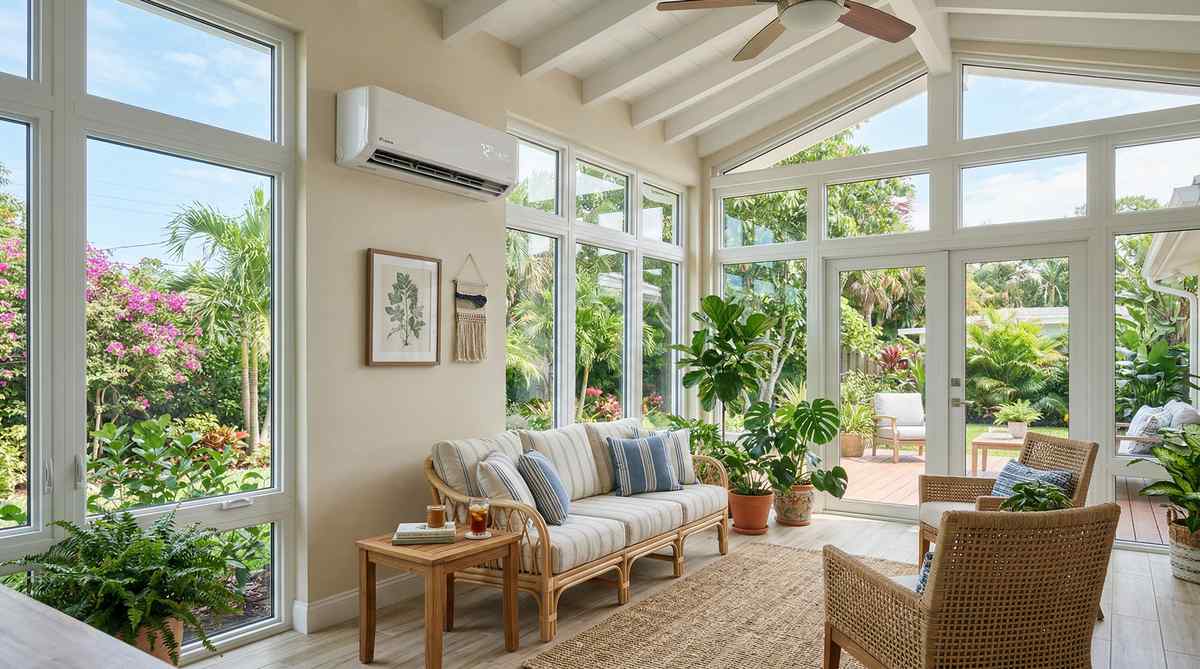
- Florida rooms and screen enclosures: These spaces often have glass on multiple sides, creating high solar gain loads that overwhelm an extension of the central system. A dedicated mini-split sized specifically for the glass load is far more effective.
- Converted garages: Garages have concrete floors, often no insulation in the walls, and a large overhead door that contributes significant heat gain. A central system extension would require major duct modifications. A mini-split installs in a day.
- Detached structures: Workshops, she-sheds, pool houses, and guest cottages cannot connect to the central system without major electrical and refrigerant line runs. A mini-split with its own outdoor unit solves this cleanly.
- Attic heat: In Polk County, attic temperatures regularly hit 140 degrees in summer. Any ductwork running through the attic to serve a new addition experiences enormous heat gain. Mini-splits avoid this entirely.
Efficiency: How Mini-Splits Compare to Central AC
Modern ductless mini-splits offer some of the highest efficiency ratings in the residential HVAC market:
| System Type | Typical SEER2 Range | Duct Losses | Zone Control |
|---|---|---|---|
| Standard central AC (single-stage) | 14.3 to 16 SEER2 | 20 to 30% (attic ducts) | Whole-home only |
| High-efficiency central AC (variable-speed) | 18 to 24 SEER2 | 20 to 30% (attic ducts) | Limited with zoning |
| Ductless mini-split (single-zone) | 18 to 30+ SEER2 | None | Room-by-room |
| Multi-zone mini-split | 16 to 24 SEER2 | None | Individual zone control |
Multi-Zone Systems for Multiple Additions
If you have multiple spaces that need independent cooling, a multi-zone mini-split system allows a single outdoor unit to serve multiple indoor air handlers, each with their own thermostat and independent control. This is more cost-effective than installing two separate systems when the spaces are in proximity to each other.
Multi-zone systems in Florida are commonly used for: a primary bedroom plus Florida room with different comfort preferences, main living area plus home office where office equipment generates significant heat load, multiple bedrooms in a renovation where ductwork extension is impractical, and entire home replacement with all ductwork removed, which is increasingly common in older Florida homes with failed duct systems.
Installation Process for Florida Additions
A standard single-zone mini-split installation in a Polk County addition typically takes 4 to 8 hours and involves:
- Mounting the indoor air handler on an interior wall, high on the wall for best airflow distribution
- Routing refrigerant line set through the wall, typically through a 3-inch core-drilled hole with weatherproof sealing
- Setting the outdoor condenser unit on a pad adjacent to the addition
- Running electrical, a dedicated 240V circuit is required for most mini-split systems
- Connecting refrigerant lines, testing for leaks, and commissioning the system
No ductwork means no major construction disruption. Most additions can be up and cooling the same day as installation.
Costs for Ductless Mini-Split Installation in Polk County
Pricing varies by system size, home size, and installation complexity.
Call (863) 875-5500 for a free in-home estimate. Every job is priced individually.
Maintenance Requirements for Florida Climate
Mini-splits require less maintenance than central systems but they do need regular attention in Florida's conditions:
- Filter cleaning monthly in Florida: Mini-split indoor units have washable mesh filters that should be cleaned monthly during heavy cooling season. Clogged filters severely reduce efficiency and can cause the indoor unit to drip water onto the floor.
- Outdoor coil cleaning annually: Florida's combination of dust, pollen, cottonwood, and vegetation debris clogs condenser coils faster than in other climates.
- Condensate drainage: Like central AC, mini-splits generate condensate. The drain must be clear and functional. In humid Florida conditions, algae can grow in mini-split drain lines just as in central system drain pans.
- Line set inspection annually: The insulation on the refrigerant line set running on the exterior of the building degrades in Florida's UV exposure. Inspect it annually and replace when cracked or brittle.
Brands Worth Considering for Florida Mini-Split Installations
Top Notch Air Conditioning & Heating installs and services several leading mini-split brands throughout Polk County. Each has specific strengths for Florida applications:
- Carrier: As a Carrier Factory Authorized Dealer, we install Carrier ductless systems with confidence. Carrier mini-splits offer up to 24 SEER2 efficiency and integrate with the Infinity thermostat system for smart home control. The Carrier 38MAQB series is particularly well-suited to Florida room and garage applications.
- Mitsubishi Electric: Mitsubishi's Hyper-Heating INVERTER technology operates down to extremely low outdoor temperatures, though that matters less in Florida. Their reputation for quiet indoor operation and precise temperature control is well-earned and popular among homeowners with home offices and media rooms.
- Daikin: Daikin manufactures a broad line of single and multi-zone systems well-suited to Florida's conditions. Their Fit series offers low-profile outdoor units ideal for homes where the condenser placement is constrained.
Regardless of brand, the most important factor is a licensed installation from a contractor who performs a proper load calculation for your specific space. A technically excellent brand installed to the wrong size for a high-sun Florida room will disappoint, while any of the above brands installed correctly will deliver years of reliable, efficient service.
Frequently Asked Questions
Can a mini-split cool a Florida room with all glass walls?
Yes, with proper sizing. All-glass Florida rooms have very high solar heat gain loads, typically 2 to 3 times the load of an equivalent insulated space. The key is proper BTU sizing based on the actual glass area, orientation, and any existing window film or tinting. A 12,000 BTU unit that would handle 500 square feet of normal space might only comfortably handle 200 to 250 square feet of all-glass Florida room exposure. We perform load calculations before recommending a size.
How long do ductless mini-splits last in Florida?
Well-maintained mini-splits typically last 15 to 20 years, longer than central AC systems in Florida. The key to longevity is regular filter cleaning monthly during heavy use, annual professional maintenance, and keeping the outdoor unit clear of vegetation. The most common failure points are the inverter control board and refrigerant connections, both of which are repairable.
Can I install a mini-split myself?
In Florida, all refrigerant work legally requires an EPA 608 certified technician. Additionally, electrical work requires a licensed electrician. An unpermitted installation may void the equipment warranty and create issues when selling the home. The cost savings of DIY installation are generally not worth these risks.
Does Top Notch Air Conditioning & Heating service mini-splits from other brands?
Yes. We install and service mini-split systems from Carrier, Mitsubishi, Daikin, LG, and other major brands. If you have an existing mini-split that needs service or is not performing correctly, call us for a diagnostic appointment.
Do I need a permit for a mini-split installation in Polk County?
Yes. Mini-split installations in Florida require a mechanical permit from the Polk County building department. Top Notch Air Conditioning & Heating pulls all required permits on your behalf as part of the installation process. Installing without a permit can create problems when selling your home and may void manufacturer warranties.
Conclusion
For Florida homeowners with additions, conversions, or spaces that the central system cannot adequately serve, ductless mini-splits are the cleanest, most efficient, and most practical solution. They install quickly, require no ductwork modification, provide independent temperature control, and deliver excellent performance in Florida's demanding climate. If you are planning an addition or struggling with a space that never gets comfortable, call Top Notch Air Conditioning & Heating to schedule a free assessment and get a same-day estimate.