Quick Answer
When an AC runs but doesn't cool in Lakeland, the eight most common causes are: a dirty air filter, low refrigerant from a leak, a failed capacitor, a frozen evaporator coil, a dirty condenser coil, a failing compressor, incorrect thermostat settings, or ductwork leaks. Start with the free checks (filter and thermostat), then call a licensed technician for anything else. For AC repair in Lakeland, FL, call Top Notch Air Conditioning & Heating at (863) 875-5500.
There are few things more miserable than a Lakeland summer afternoon with a broken air conditioner. When the temperature outside climbs past 93°F and the humidity from Lake Hollingsworth and the surrounding lakes pushes the heat index above 105°F, a non-cooling AC is a serious health concern for most families — especially those with young children, elderly relatives, or pets.
The good news: not every non-cooling situation requires an expensive repair. Some causes are quick DIY fixes. Others require a licensed technician. This guide walks through all eight common causes in order from simplest to most complex, so you can triage the situation before calling for service.
Before You Call: Two Free Checks
Before spending money on a service call, check these two things — they account for a surprising percentage of "AC not cooling" calls that turn out to be homeowner-fixable problems:
- Check your air filter. A clogged filter restricts airflow so severely that the system cannot move enough air across the evaporator coil to absorb heat. In Lakeland's dusty, pollen-heavy environment — especially near Dixieland and the areas around Lake Hollingsworth where oak trees are abundant — filters can clog in as little as 3–4 weeks. Pull the filter and hold it up to light. If you cannot see light through it, replace it immediately with a new filter of the same size.
- Check your thermostat settings. Make sure it is set to COOL (not HEAT or FAN ONLY) and that the setpoint is at least 3–5 degrees below current room temperature. Also verify that no one changed it accidentally and that the display is lit (low batteries on battery-powered thermostats cause strange behavior).
If both check out fine, you are dealing with one of the following eight causes:
Cause 1: Low Refrigerant From a Leak
Refrigerant is the substance that makes cooling possible — it cycles through the system absorbing heat from your home's air and releasing it outside. When the refrigerant level drops due to a leak, the system loses cooling capacity. Lakeland homes, especially those with systems 8–12+ years old, are particularly prone to refrigerant leaks because of a process called formicary corrosion, where acidic byproducts eat pinholes through copper coils over time.
Signs of low refrigerant include: air that is cool but not cold, ice forming on refrigerant lines near the air handler, a hissing or bubbling sound near the indoor unit, and significantly higher electricity bills. Low refrigerant cannot be fixed by simply adding more — the leak must be located and repaired first. Call (863) 875-5500 for a free quote on refrigerant leak repair.
Cause 2: Failed Capacitor
The capacitor is a cylindrical component in the outdoor unit that provides the electrical surge to start the compressor and fan motor. Florida's heat degrades capacitors faster than almost anywhere else — the combination of high temperatures inside the condenser cabinet and continuous heavy use throughout Lakeland's 10-month cooling season is brutal on these components.
When a capacitor fails, the compressor or outdoor fan motor will not start. You may hear the outdoor unit humming but not running, or the unit may start and immediately shut down. Sometimes you'll see the outdoor fan not spinning while the indoor unit runs fine — a telltale sign of a failed run capacitor. This is one of the most common and most affordable AC repairs in Lakeland. Call (863) 875-5500 for same-day service.
Cause 3: Frozen Evaporator Coil
Despite Lakeland's blazing summers, your indoor AC evaporator coil can develop a solid block of ice — and when it does, airflow through the unit drops to near zero, causing the system to blow warm or room-temperature air even though it is technically running.
Coil freezing is caused by either severely restricted airflow (from a clogged filter or blocked return vents) or low refrigerant that causes the coil to run colder than designed. If you look at your air handler and see frost or ice on the refrigerant lines coming out of it, you have a frozen coil situation.
What to do immediately: turn the system to OFF at the thermostat (or switch to FAN ONLY to help it thaw faster). Do not chip ice off the coil. Let it thaw completely — usually 2–4 hours. Then replace your air filter if it is dirty and restart the system. If it freezes again within a day, you have a refrigerant problem that requires a technician.
Cause 4: Dirty Condenser Coil
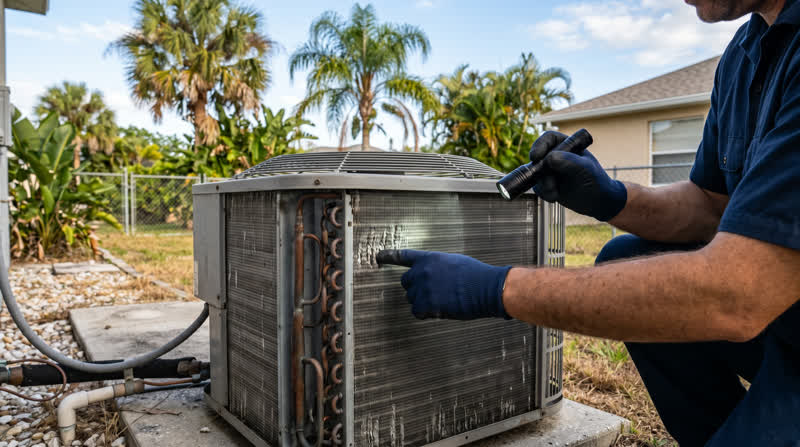
The outdoor condenser coil is responsible for releasing heat collected from your home's air into the outside environment. When the coil becomes coated in dirt, pollen, grass clippings, or cottonwood fluff — all common in Lakeland's outdoor environment — it cannot release heat efficiently. The system runs but transfers heat poorly, resulting in significantly reduced cooling output.
Lakeland homeowners near Grasslands or South Lakeland who have landscaping close to their outdoor units are particularly prone to this issue. Bushes or fencing within 18 inches of the unit can restrict airflow enough to cause significant performance degradation. A condenser coil cleaning by a technician makes a dramatic difference in cooling performance.
Cause 5: Failing or Failed Compressor
The compressor is the heart of your air conditioning system — it pressurizes the refrigerant and drives the entire refrigeration cycle. When a compressor begins to fail, it may still run but with reduced capacity, leading to inadequate cooling even on days that are not extreme. A completely failed compressor means no cooling at all.
In Lakeland, compressor failures are more common than in cooler climates because the unit operates year-round under heavy load. Early signs of compressor problems include the system running but barely cooling, a tripping breaker when the AC tries to start, loud clanking or grinding from the outdoor unit, or unusually high electrical consumption. Compressor replacement is the most expensive common AC repair, and on systems 10+ years old, full replacement of the system is often the more sensible investment. Call (863) 875-5500 for an honest assessment.
Cause 6: Ductwork Leaks
This cause is particularly relevant to Lakeland's older housing stock. Homes in Dixieland, Cleveland Heights, Crystal Lake, and other established neighborhoods often have ductwork that is 30–50 years old. Flex duct connections loosen over time, joints separate, and duct board degrades in Florida's humid attic environment. When ducts leak, the cool air your system produces escapes into the attic instead of reaching your living spaces.
A home with 25% duct leakage (common in older Lakeland homes) is effectively losing a quarter of its cooling before it reaches the rooms that need it. The system runs constantly, electricity bills climb, and the house never quite gets comfortable — especially upstairs or in rooms furthest from the air handler. Duct leakage testing and sealing can be performed by a qualified HVAC technician.
Cause 7: Oversized or Undersized Equipment
Equipment that is the wrong size for your home will never cool properly, regardless of its condition. An oversized system cools the air temperature quickly but shuts off before removing humidity — leaving the home feeling cold but clammy, which is a real comfort problem in Lakeland's high-humidity environment. An undersized system runs constantly and still cannot maintain setpoint temperature during peak afternoon heat.
This issue is common in Lakeland homes that have had additions built (adding square footage without upgrading the AC), homes that replaced equipment without doing a proper load calculation, and older South Lakeland subdivisions where builders sometimes installed smaller equipment to cut initial costs. Solving it requires a proper Manual J load calculation and, if equipment is significantly sized wrong, a system replacement.
Cause 8: Electrical and Control Board Issues
Lightning is a frequent occurrence in Lakeland during the summer storm season, and power surges from nearby strikes can damage capacitors, contactors, and control boards. A damaged control board may cause the system to behave erratically — running the indoor blower but not the compressor, cycling on and off incorrectly, or displaying error codes. Call (863) 875-5500 for diagnostics and repair.
Lakeland homeowners in areas prone to power fluctuations should consider installing a whole-home surge protector on their electrical panel to protect both the HVAC system and other major appliances.
| Cause | DIY Fix? |
|---|---|
| Clogged air filter | Yes — replace filter ($5–$25 at any hardware store) |
| Wrong thermostat settings | Yes — check settings (free) |
| Refrigerant leak | No — licensed tech required. Call for quote |
| Failed capacitor | No — electrical hazard. Call for quote |
| Frozen evaporator coil | Partial — thaw and check filter. Call for service if it recurs |
| Dirty condenser coil | Partial — clear debris; professional cleaning recommended. Call for quote |
| Compressor failure | No — major repair. Call for honest assessment |
| Ductwork leaks | No — requires testing. Call for quote |
Lakeland-Specific Factors That Make Cooling Harder
Even a well-functioning Lakeland AC system works harder than systems in most of the country. Several factors specific to Lakeland's environment create additional cooling challenges:
- Lake-effect humidity: Proximity to Lake Hollingsworth, Lake Morton, Lake Mirror, and Crystal Lake keeps overnight humidity elevated, meaning the system never gets a full break even during cooler nights.
- Older home insulation: Many of Lakeland's 1950s–1970s ranch homes in Dixieland, Cleveland Heights, and Kathleen have inadequate insulation by modern standards. Heat infiltration through poorly insulated attics and walls adds significantly to the cooling load.
- Attic heat gain: Unventilated or poorly ventilated attics in Lakeland's slab-on-grade homes can reach 150–160°F during summer afternoons. Ductwork running through these attics gains significant heat, reducing delivered cooling efficiency.
- Sun exposure: Lakeland averages over 233 sunny days per year. West-facing windows without adequate shading can increase cooling loads by 20–30% during afternoon hours.
Frequently Asked Questions
My AC is running but the house is 80°F — what's the most likely problem?
The most common causes in Lakeland are low refrigerant, a dirty condenser coil, or a failing compressor. First check your air filter and thermostat. If those are fine, call for a diagnostic. A technician can quickly check refrigerant pressure and condenser condition to narrow down the cause.
How long should it take my AC to cool down a Lakeland home on a hot day?
On a typical Lakeland summer day (90–93°F), a properly functioning system should be able to maintain your setpoint if you keep it at 75–78°F. Dropping a hot home 10 degrees from midday heat may take 45–90 minutes. If it takes more than 2–3 hours to reach setpoint from a standing start, something is wrong with the system or the home's insulation and air sealing.
Can I clean my own condenser coils?
You can clear debris and spray the exterior fins with a garden hose from the inside out, but deep cleaning requires fin combs, coil cleaner, and care not to damage the fins. For Lakeland homeowners with heavily fouled coils, professional cleaning is safer and more effective. A good rule: clear visible debris and rinse seasonally, and schedule professional cleaning annually as part of a tune-up.
Does the age of my Lakeland home affect how well my AC cools?
Yes, significantly. Lakeland's 1950s–1970s ranch homes typically have R-11 insulation (which is about half the modern minimum), single-pane windows, and ductwork that has had decades to develop leaks. These homes have substantially higher cooling loads than newer construction. If your older Lakeland home never seems to cool properly, it may be worth having a load calculation performed to see if your equipment is appropriately sized for the actual building conditions.
What to Do Right Now
If your AC is not cooling your Lakeland home properly today, here is the sequence to follow:
- Step 1: Check the air filter — replace if dirty
- Step 2: Verify thermostat is on COOL and set below current room temperature
- Step 3: Check the outdoor unit — is the fan spinning? Any obvious debris blocking it?
- Step 4: Check the indoor air handler for ice on the refrigerant lines
- Step 5: If steps 1–4 find nothing obvious, call a licensed technician for a diagnostic
Top Notch Air Conditioning & Heating serves all of Lakeland, FL from our Winter Haven base. Call (863) 875-5500 to schedule a diagnostic visit, and our technicians will identify the exact cause and provide an upfront written estimate before any repair work begins.