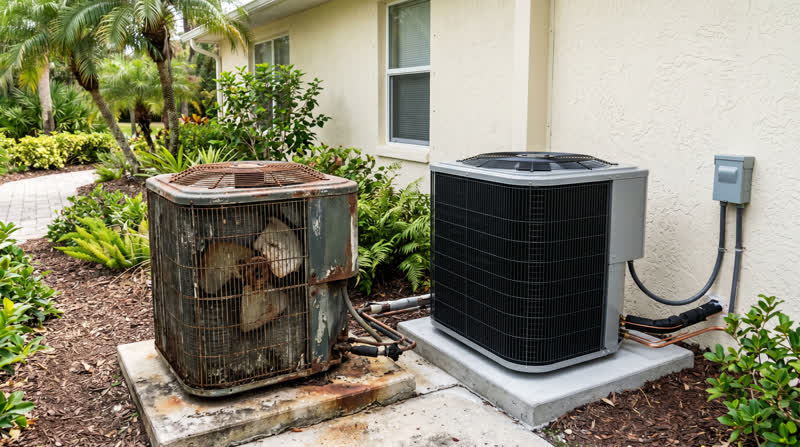
Quick Answer
In Lakeland's climate, most AC systems need replacement after 12–15 years, significantly sooner than the 15–20 year lifespan advertised in northern states. The 8 clearest signs it is time to replace are: system age past 12–15 years, the repair cost exceeds 50% of replacement cost, using R-22 refrigerant with a leak, multiple repairs in the past two years, compressor failure, inability to cool to setpoint during peak heat, dramatically rising utility bills, and repeated short-cycling. For AC installation in Lakeland, FL, call Top Notch Air Conditioning & Heating at (863) 875-5500.
The repair-or-replace question is one of the most financially significant decisions Lakeland homeowners face. There is no universal right answer, it depends on your specific system, its age, repair history, and the honest assessment of its remaining useful life. What is unique about Lakeland is that Florida's extreme AC demands compress the useful life of residential equipment compared to national averages. A system that might run 18–20 years in a mild climate often reaches the end of practical reliability at 12–15 years in Lakeland's year-round heat.
This guide covers the 8 clearest signs that replacement makes more sense than another repair, covering homes throughout Lakeland from South Lakeland and Grasslands to Kathleen, Medulla, Highland City, and Combee Settlement.
Why AC Systems Age Faster in Lakeland
Before examining the replacement signs, it helps to understand why Lakeland's climate compresses AC lifespan. Every mechanical component in an AC system has a finite number of operating cycles, starts, stops, and hours of operation under load. In northern states, an AC system might run 800–1,200 hours per year. In Lakeland, that same system runs 2,800–3,500 hours per year.
A 10-year-old Lakeland AC system has experienced roughly the same number of operating hours and thermal stress cycles as a 20–25 year old system in a moderate climate. Compressors, capacitors, contactors, coils, and fan motors all wear on cumulative operating time, not calendar years. This is why industry lifespan estimates designed for national averages do not apply cleanly to Lakeland homeowners.
Sign 1: Your System Is 12–15 Years Old or More
Age alone does not guarantee replacement is the right choice, but it is the most important context for every other decision. Once a Lakeland AC system passes 12 years, it has entered the phase where major component failures become increasingly probable. Compressors, evaporator coils, and condenser coils in aging systems can fail with little warning, and the cost of these repairs approaches or exceeds the cost of a new system in many cases.
A system that is 15 years old or more in Lakeland has genuinely provided its reasonable service life. Even if it has not failed catastrophically, its efficiency has degraded significantly from its original SEER rating, older systems lose 10–20% of their rated efficiency as components age, seals wear, and coils lose heat transfer efficiency. You are paying more each month to get less cooling performance.
Sign 2: The 50% Rule, Repair Cost vs. Replacement Value
The most widely used rule of thumb for repair versus replacement is: if the repair cost exceeds 50% of the cost of a new system, replacement is almost always the better financial decision. In Lakeland's context, this threshold can be adjusted downward, because you are making the replacement decision on a system whose remaining useful life is short.
| System Age | Repair Cost Threshold to Consider Replacement |
|---|---|
| Under 5 years | Repair virtually always makes sense unless compressor failed |
| 5–8 years | Repair if under 50% of replacement cost |
| 8–12 years | Repair if under 35% of replacement cost |
| 12–15 years | Consider replacement for significant repairs, call for a free assessment |
| 15+ years | Replacement strongly favored for most significant repairs |
Sign 3: Your System Uses R-22 Refrigerant and Has a Leak
R-22 refrigerant (commonly called Freon) was phased out of production under the Montreal Protocol due to its ozone-depleting properties. As of January 2020, R-22 cannot be manufactured or imported in the U.S. The remaining supply comes from reclaimed refrigerant at very high cost.
Any Lakeland AC system installed before approximately 2010 likely uses R-22. If that system develops a refrigerant leak, which requires leak repair plus refrigerant recharge, the total cost can be very high for a system that will continue to degrade and may develop additional leaks. For an R-22 system that is also 15+ years old, this is almost always the tipping point into replacement territory.
Sign 4: Multiple Significant Repairs in the Past Two Years
One capacitor replacement is normal maintenance. Two compressor-related repairs, a refrigerant leak, and a control board failure in a 24-month period is a different story, it is a pattern indicating that the system is in overall decline, and each repair is buying less and less remaining reliability. Track your repair costs: if recurring repairs are adding up on a system that is more than 10 years old, replacement often becomes financially competitive with continued repair spending.
Sign 5: Compressor Failure on an Older System
Compressor replacement is a major expense. For a system that is 10–12 years old or older, spending that amount on a single repair is rarely the best financial decision. A new system comes with a 10-year parts warranty on most major brands installed by a factory-authorized dealer. Replacing the compressor on an aging system gives you a repaired component with no warranty sitting inside aging coils, aging capacitors, and aging motor components, all of which are likely to fail soon. Call (863) 875-5500 for a free estimate.
Sign 6: The System Cannot Keep Up With Lakeland Summer Heat
When an AC system struggles to maintain the thermostat set temperature during Lakeland's peak summer heat, the system runs constantly but the house climbs above the set point by 3–5°F on 90°F+ days, this is a performance failure that often cannot be fixed with repairs. It may indicate an undersized system, severe efficiency degradation from coil fouling or refrigerant loss, or a combination of factors that effectively end the system's useful life regardless of its age.
An AC that cannot provide comfort during Lakeland summers is not a functional system. Homeowners in Dixieland, Lake Hollingsworth, and South Lakeland who find themselves running window units to supplement a supposedly functional central AC are experiencing this failure mode.
Sign 7: Dramatically Higher Utility Bills
When energy bills spike, particularly during months when usage patterns have not changed significantly, aging AC system inefficiency is often the culprit. An older system may have dropped from its original 14–16 SEER rating to an effective efficiency of 9–10 SEER due to refrigerant loss, coil degradation, worn motor components, and duct leakage. The system works harder and harder for diminishing cooling output, reflected directly in your FPL or Duke Energy bill.
Comparing your current utility bills to bills from 5 years ago (adjusting for rate increases) can reveal the magnitude of efficiency loss. In many cases, the monthly energy savings from a new high-efficiency system are substantial enough to contribute meaningfully to the payback on the installation cost.
Sign 8: Repeated Short-Cycling or Humidity Problems
An AC system that turns on and off every 2–3 minutes (short-cycling) or one that cannot adequately reduce indoor humidity despite running constantly may be oversized for the home, have a refrigerant issue, or be experiencing compressor or control board deterioration. In Lakeland's climate, humidity control is not optional, a home that stays humid at 73°F feels uncomfortable and promotes mold growth.
If a properly-sized, well-maintained system suddenly develops persistent humidity problems or short-cycling, a refrigerant issue or compressor fault is usually the cause. But if these symptoms develop gradually in an aging system over several years, it often indicates overall system decline that repairs will not resolve permanently.
When Replacement Pays Off in Lakeland
Replacing an aging, inefficient system in Lakeland typically pays back through:
- Energy savings: A new 16 SEER2 system replacing a 15-year-old system running at effective 9–10 SEER can reduce cooling costs by 40–50% annually
- Repair elimination: The ongoing repair costs of an aging system can add up significantly year over year. A new system under warranty eliminates most of these costs for 10 years.
- Comfort improvement: Variable-speed systems provide dramatically better humidity control, a meaningful quality-of-life improvement in Lakeland's climate
- Home value: A new, modern AC system is a documented home value increase, particularly important in Lakeland's active real estate market
Top Notch Air Conditioning & Heating offers 0% financing through Wisetack up to $25,000, making the investment manageable for Lakeland homeowners. Visit our Lakeland AC installation page for more information.
Frequently Asked Questions About Replacing Your Lakeland AC
How long should an AC last in Lakeland, FL?
With regular maintenance, most central AC systems in Lakeland last 12–16 years before replacement becomes the practical choice. Some well-maintained systems on mild duty may last 18 years, but this is less common in Florida's demanding climate than the national average would suggest. Preventive maintenance with twice-yearly tune-ups, as provided through the Yeti Club plan, meaningfully extends system lifespan.
What is the best time of year to replace an AC in Lakeland?
The best time to replace an AC in Lakeland is fall or winter, September through February, when demand on HVAC companies is lowest and scheduling is most flexible. Prices may be slightly more negotiable off-season, and installation crews have more time for thorough, careful work. Emergency replacements during summer peak demand (June through August) carry the risk of rushed installation and equipment availability constraints.
Should I repair my 12-year-old AC or replace it?
At 12 years in Lakeland's climate, the decision hinges on repair cost and system condition. A minor repair on a system that has otherwise run reliably may still be worthwhile. A major repair, especially any compressor-related failure, on a 12-year-old Lakeland system typically makes replacement the better financial choice. Request a full system condition assessment before committing to an expensive repair on a system in this age range.
What brands does Top Notch recommend for AC replacement in Lakeland?
Top Notch Air Conditioning & Heating is a Carrier Factory Authorized Dealer. We install Carrier systems exclusively and service and repair all major HVAC brands throughout Lakeland. Call (863) 875-5500 and we will recommend the right Carrier system for your Lakeland home and budget.
Is the 50% repair rule a reliable guide for Lakeland homeowners?
The 50% rule is a useful starting point, but in Lakeland it should be applied more conservatively on older systems. The rule assumes you are buying meaningful remaining life with the repair, but a 13-year-old Lakeland AC system may only have 2–3 years of reliable remaining life even after a successful major repair. A more useful framework is: multiply the repair cost by the estimated remaining years of reliable service, and compare that to the cost of a new system with a 10-year warranty.
Conclusion: Make the Replacement Decision on Your Terms
The best time to evaluate replacing your Lakeland AC is before it fails catastrophically in the middle of a July heat wave, when you have no bargaining power, limited equipment choices, and may need to make a rushed decision. Reviewing the 8 signs described in this guide now, while your system is still functional, gives you time to plan, budget, and choose the right system and contractor without pressure.
Top Notch Air Conditioning & Heating provides free, no-obligation estimates for AC replacement in Lakeland and all of Polk County. With a 4.9-star rating from 615+ Google reviews, Carrier Factory Authorized Dealer status, and license CAC1817537, we give Lakeland homeowners honest, transparent guidance. Call (863) 875-5500 or schedule a free estimate online.