Quick Answer
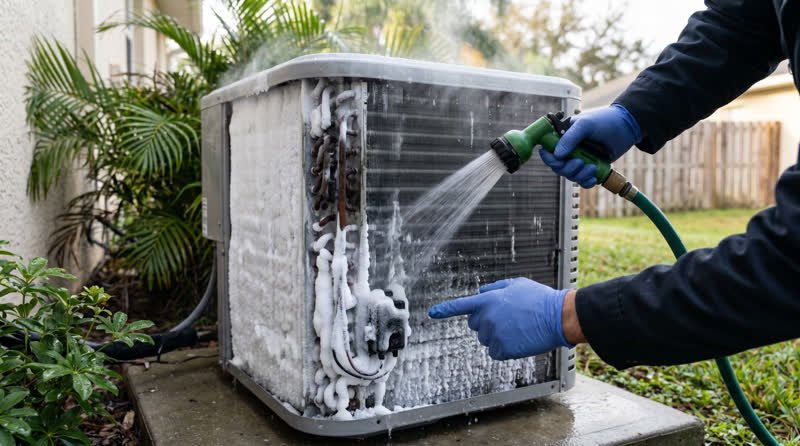
A light, even coating of frost on your heat pump's outdoor coil during cold mornings in Davenport is completely normal — the system's built-in defrost cycle melts it automatically every 30–90 minutes. What is not normal is thick sheet ice that encases the entire unit, blocks the outdoor fan, or stays frozen for hours. That kind of freeze indicates a failed defrost board, a stuck reversing valve, low refrigerant, restricted airflow, or a blocked outdoor unit. Call (863) 875-5500 to reach Top Notch Air Conditioning & Heating — we diagnose heat pump freezing issues throughout Davenport and all of Polk County.
Davenport homeowners are sometimes surprised to find ice forming on the outdoor unit of their heat pump during December through February. It looks alarming — but the reality depends entirely on what kind of ice you're seeing and whether the system is clearing it on its own. This guide explains exactly how defrost cycles work, what causes them to fail, and when you need a heating repair professional.
Frost vs Ice: What's Normal on a Heat Pump in Florida Winter
Heat pumps operate on the same principle as your air conditioner, but in reverse. During heating mode, the refrigerant absorbs heat energy from the outdoor air — even when that air feels cold — and transfers it indoors. As the outdoor coil pulls heat from cold air, moisture in the air condenses on the coil fins and can freeze, especially when outdoor temperatures drop into the 30s and low 40s.
Polk County's "cool corner" around Davenport, ChampionsGate, and Reunion sees more legitimate heating demand than many Florida residents expect. The US-27 corridor and Highway 17/92 areas can experience overnight lows in the mid-30s during January and February — cold enough that every heat pump in the neighborhood is working in heating mode and building frost on its outdoor coil.
Normal frost looks like:
- A thin, even white coating across the coil fins — not solid ice
- Frost that disappears periodically on its own (the defrost cycle cleared it)
- Light frost visible in the early morning that is gone by mid-morning
Problematic ice looks like:
- Thick, solid ice sheets that cover the entire coil or base pan
- Ice that encases the outdoor fan blade and prevents it from spinning
- Ice that builds continuously over multiple hours without melting
- Ice that extends up the refrigerant lines running into the house
If you're seeing the second type, the defrost system has failed or something is preventing it from doing its job. Call (863) 875-5500 before running the system further — a fan motor seized by ice can burn out within minutes.
How a Defrost Cycle Should Work
Modern heat pumps include an automatic defrost control system designed to prevent ice buildup from getting out of hand. Understanding how it works helps you recognize when something has gone wrong.
Defrost Board and Thermostat Sensor Logic
The defrost control board monitors two inputs: time and temperature. A thermistor (temperature sensor) clipped to the outdoor coil tells the board how cold the coil is. The board tracks how long the system has been running in heating mode. When the coil drops to a threshold temperature — typically around 26°F — and enough time has elapsed (usually 30, 60, or 90 minutes depending on the setting), the board triggers a defrost cycle. If the sensor is faulty or the board itself is fried, the logic never fires and ice accumulates unchecked.
Reversing Valve Flips to Cooling Mode Briefly
When defrost is triggered, the system's reversing valve shifts the refrigerant flow back into cooling mode for a short period. In cooling mode, the outdoor coil becomes the condenser — it gets hot instead of cold — and that heat melts the accumulated ice rapidly. The reversing valve is a solenoid-operated component; if it sticks in heating position, the system cannot flip to defrost mode and ice keeps building.
Outdoor Fan Stops, Indoor Blower Continues
During defrost, the outdoor fan motor is intentionally shut off. This traps heat around the outdoor coil, accelerating ice melt. Meanwhile, the indoor blower continues to run to keep air moving through the house. You may notice a brief rush of slightly cooler air indoors during this phase — this is normal.
Auxiliary Heat Strip Kicks In for Indoor Comfort
Because the system is briefly running in cooling mode during defrost, the air coming from your vents could feel cool. To compensate, the system activates the auxiliary electric heat strip in the air handler. The heat strip maintains indoor warmth while the outdoor coil defrosts. If the auxiliary heat strip has failed, your home may feel noticeably cooler during defrost cycles — and if the stat keeps calling for heat because the strip cannot satisfy the setpoint, the system may never get an adequate chance to defrost.
Typical Duration: 5–15 Minutes
A normal defrost cycle lasts 5 to 15 minutes. The board ends defrost when the coil sensor reads warm enough (typically 57–65°F, indicating ice is cleared) or when a maximum time limit is reached (usually 10–14 minutes). After defrost, the reversing valve flips back to heating mode, the outdoor fan restarts, and normal operation resumes. If your system seems to be stuck in what feels like an extended defrost — or never seems to defrost at all — it needs diagnosis. Call (863) 875-5500 and we'll send a licensed technician to your Davenport home.
Top Causes of a Heat Pump That Won't Defrost or Keeps Freezing
When a Davenport heat pump is encased in ice or running constantly without ever defrosting, one or more of the following components is usually to blame. Top Notch Air Conditioning & Heating diagnoses all of these systematically on every heat pump freezing service call.
Failed Defrost Board or Sensor
The defrost control board and its coil temperature sensor are the most common failure points in a heat pump that won't defrost. The board is an electronic circuit board subject to power surge damage, moisture infiltration, and age-related component failure. The sensor (thermistor) can shift out of calibration or develop an open circuit, sending incorrect readings to the board. Either failure prevents the defrost cycle from initiating. Replacement is straightforward once confirmed by diagnosis — boards typically run $385–$650 including labor.
Stuck Reversing Valve
The reversing valve is a four-way valve that physically redirects refrigerant flow. It is operated by a solenoid coil that energizes magnetically to shift the valve's slide mechanism. The valve can stick in heating position due to pressure equalization issues, debris in the refrigerant circuit, or a failed solenoid coil. A stuck reversing valve means the system cannot switch to cooling mode during defrost — so ice never melts. This is one of the more expensive repairs at $850–$1,450, and requires a licensed EPA 608-certified technician to handle the refrigerant.
Low Refrigerant Charge / Refrigerant Leak
Low refrigerant causes the outdoor coil to run colder than designed, dramatically increasing ice formation. At the same time, a low charge reduces system efficiency in heating mode so the system runs longer and builds more frost faster than the defrost cycle can handle. Low refrigerant always means there is a leak somewhere — refrigerant does not "get used up." The leak must be located and repaired before recharging. Refrigerant recharge runs $325–$675 depending on the refrigerant type and system size, plus the cost of leak location and repair if needed.
Dirty Outdoor Coil (Pollen, Debris)
Davenport's proximity to Posner Park, the Loughman area, and Polk County's agricultural corridors means outdoor air carries significant pollen, dust, and fine debris, particularly in spring. When this material coats the outdoor coil fins, it acts as insulation, preventing proper heat transfer. The coil runs colder, frost forms faster, and the defrost cycle struggles to clear it. An annual coil cleaning is standard in our heating maintenance visits.
Restricted Airflow at Indoor Coil (Filter, Blower, Ducts)
Restricted indoor airflow reduces the system's ability to move heat efficiently, which increases operating pressures and can cause the outdoor coil to freeze even harder. A clogged air filter is the single most common and most preventable cause. Check your filter first — if it is visibly gray and compacted, replace it immediately. If the filter is clean but airflow still seems low, the issue may be a failing blower motor, collapsed flex duct, or undersized return air — all of which require professional diagnosis.
Failed Outdoor Fan Motor
If the outdoor fan motor fails while the system is running, airflow across the outdoor coil stops. Without airflow, the coil temperature plummets and the entire unit can ice over rapidly. A failed outdoor fan motor is easy to spot — the compressor is running (you can hear it) but the fan blade is not turning. Do not operate the system with a non-functioning outdoor fan; compressor damage can follow quickly. Fan motor replacement typically runs $475–$895.
Outdoor Unit Blockage (Mulch, Leaves, Branches)
Landscaping installed around heat pumps in Davenport neighborhoods along the US-27 corridor — mulch beds, ornamental shrubs, lawn cuttings — can restrict the outdoor unit's airflow intake. Debris collected in the base pan reduces drainage and causes water to freeze in the pan during cold weather, restricting airflow from below. Keep at least 18–24 inches of clearance on all sides of the outdoor unit and remove any debris from the base pan after wind events or yard work near the Loughman and ChampionsGate communities.
Auxiliary Heat Strip Failure (Causes Constant Heat Call)
When the auxiliary heat strip fails, the thermostat keeps calling for heat because the system cannot satisfy the setpoint during defrost or during near-peak heating demand. Constant heat calls mean the system runs without adequate pause, building ice faster than any defrost cycle can clear. You may notice "AUX HEAT" or "EM HEAT" lit on your thermostat constantly. Strip replacement runs $385–$725 depending on strip capacity and whether the element, breaker, or sequencer is at fault.
Normal vs Not Normal Frost Patterns
Use this reference table when inspecting your outdoor unit on a cold Davenport morning. If you identify a "Not Normal" pattern, call (863) 875-5500 before running the system further.
| Pattern | Normal? | What It Means | Action |
|---|---|---|---|
| Light, even white frost on coil fins | Yes | Normal heat exchange condensation in cold weather | Monitor — defrost should clear it |
| Frost disappears on its own, returns later | Yes | Defrost cycle is working correctly | No action needed |
| Frost only on bottom half of coil | Usually yes | Cold base air; normal in 30s–40s temps | Watch for progression; call if it spreads |
| Thick ice on top of unit / all sides | No | Defrost not firing; possible board/valve failure | Shut off system; call for service |
| Fan blade encased in ice | No | Fan motor at risk of burnout | Shut off immediately; call for service |
| Ice on refrigerant line going into house | No | Low refrigerant or severe airflow restriction | Shut off; call for refrigerant check |
| Ice in base pan, unit draining poorly | No | Clogged drain ports or unit installed unlevel | Clear debris; have tech check drainage |
| Steam coming off unit during defrost | Yes | Ice melting rapidly — defrost cycle working | No action needed |
Heat Pump Repair Costs in Polk County (2026)
These cost ranges reflect typical repair pricing for Davenport and Polk County homeowners in 2026. Actual costs depend on system brand, unit age, refrigerant type, and parts availability. Top Notch Air Conditioning & Heating provides written upfront estimates before any work begins — no surprise charges.
| Repair | Typical Cost | Notes |
|---|---|---|
| Defrost board replacement | $385–$650 | Includes sensor if needed; most common defrost fix |
| Reversing valve replacement | $850–$1,450 | Requires refrigerant recovery and recharge; labor-intensive |
| Refrigerant recharge | $325–$675 | Plus leak locate and repair cost; leak must be fixed first |
| Outdoor fan motor | $475–$895 | Includes capacitor if needed; protects compressor |
| Contactor | $185–$345 | Often replaced alongside capacitor during tune-up |
| Capacitor | $175–$325 | Run and start capacitors; dual capacitors more common |
| Auxiliary heat strip | $385–$725 | Includes element, sequencer, or breaker depending on fault |
All repairs include a $99 service call / diagnostic fee. Yeti Club members receive 10% off repair costs — but the $99 service call fee is not waived for members.
Why Davenport Heat Pumps See These Issues
Davenport occupies what locals sometimes call Polk County's "cool corner." Situated west of the Four Corners area, the Davenport, ChampionsGate, and Reunion communities experience cooler winter mornings than much of central Florida. January lows along the US-27 corridor frequently drop into the low-to-mid 40s, and brief dips into the upper 30s occur multiple times each winter — particularly in subdivisions and golf communities along Highway 17/92 and in the Loughman and Ronald Reagan Pkwy areas west of Posner Park.
That matters for heat pumps because those temperatures — 35°F to 45°F — are precisely the range where frost formation is heaviest and defrost systems are stressed the most. Unlike Miami or even Orlando, Davenport heat pumps actually need to perform in legitimate heating demand conditions. A defrost board that has been limping along undetected may work fine through ten Florida winters and then fail during the eleventh when overnight lows are consistently in the 38–42°F range for a week straight.
The rapid residential development around ChampionsGate and the resort communities near Reunion also means many homes have systems installed in 2015–2020 that are now reaching the age where defrost board failure, capacitor wear, and contactor degradation become statistically likely. If your system was installed during that building boom and has never had the defrost board or sensors checked, it is worth having a technician verify their condition before next winter season.
Carrier Heat Pumps — Top Notch Installs
Top Notch Air Conditioning & Heating is a Carrier Factory Authorized Dealer, which means our technicians receive Carrier-specific training and we have access to genuine Carrier parts for every system we service and install. When a Davenport homeowner needs to replace a heat pump, we recommend three Carrier tiers based on budget and performance goals:
- Carrier Infinity 19VS — Variable-speed compressor, up to 19 SEER2, extremely quiet operation, Infinity System Control compatibility. Best long-term efficiency and comfort for Davenport's mixed heating/cooling climate.
- Carrier Performance 17 — Two-stage compressor, strong SEER2 efficiency, reliable mid-tier choice for homeowners wanting upgraded performance without top-tier pricing.
- Carrier Comfort 15 — Single-stage operation, solid efficiency baseline, ideal for budget-conscious replacement or rental properties near the ChampionsGate and Reunion resort communities.
All Carrier heat pump installations through Top Notch come with a 10-year parts warranty (registered) and a separate 1-year labor warranty. Call (863) 875-5500 for a free in-home estimate on a Carrier heat pump installation in Davenport.
How Top Notch Diagnoses Heat Pump Freezing
Top Notch Air Conditioning & Heating (License CAC1817537) uses a structured 7-step process when diagnosing a frozen or non-defrosting heat pump at a Davenport home. Our technicians serve all of Polk County from our base at 164 Spirit Lake Rd, Winter Haven, FL — typically 20–30 minutes from most Davenport communities. We are open Monday–Saturday, 8 AM–5 PM, and closed Sundays.
- Visual inspection of outdoor unit. Document ice coverage extent, fan condition, base pan drainage, and unit clearances. Photograph before thawing begins.
- Safe thaw if needed. If ice is severe, the system is placed in fan-only mode or powered off to allow safe thawing before electrical and refrigerant testing. We do not use hot water — this can cause thermal shock to coil fins.
- Defrost board and sensor test. Using a multimeter and board test procedures, we verify the sensor thermistor's resistance curve matches factory spec and that the board outputs the correct signal at trigger temperature.
- Reversing valve check. We verify the valve shifts properly by monitoring suction and discharge pressures and listening for the characteristic click-hiss of the valve actuating. A stuck valve shows pressure patterns that do not match heating or cooling mode norms.
- Refrigerant pressure measurement. Suction and discharge pressures are compared against manufacturer spec for ambient temperature. Sub-normal suction pressure with superheat out of range indicates low charge; we then pressure-test for leak location.
- Indoor airflow verification. Filter condition, blower motor amp draw, and static pressure across the coil are measured. Elevated static pressure confirms a restriction; low blower amps may indicate a failing motor.
- Auxiliary heat strip test. Strip sequencers and element continuity are verified to ensure the strip can satisfy demand during defrost cycles and near-peak heating conditions.
After diagnosis, you receive a written report and upfront repair cost before any work begins. Call (863) 875-5500 to schedule a diagnostic visit for your Davenport, FL home.
Yeti Club for Heat Pump Maintenance
The best way to catch a failing defrost board, a stressed capacitor, or low refrigerant before it causes a full freeze-up is a professional maintenance visit. Top Notch Air Conditioning & Heating's Yeti Club costs $199 per year per system and includes:
- One annual tune-up per system covering both heat mode and cool mode performance — technicians verify defrost board operation, coil condition, refrigerant charge, and all electrical components during the heat-mode portion of the inspection
- Maintenance can be scheduled once a year or twice as needed based on system condition and owner preference
- 10% off all repairs — applies to parts and labor on any service visit
- Priority scheduling — Yeti Club members move ahead of the standard queue, which matters during the January cold snaps when service demand spikes across Davenport and the Polk County corridor
- The $99 service call fee applies to all visits including members — it is not waived under the Yeti Club plan
For homeowners in the ChampionsGate, Reunion, and Posner Park areas running a heat pump 12 months per year, proactive maintenance is the most cost-effective way to avoid emergency repairs. Ask about the Yeti Club when you call (863) 875-5500.
When to Call Right Now
Most heat pump freezing situations allow time for a same-day or next-day service appointment. But certain signs require immediate action:
- Outdoor temperature is below 40°F and the system is producing no heat — your home will drop to unsafe temperatures quickly, especially overnight
- Ice has completely encased the outdoor unit including the fan blade — running the system risks burning out the fan motor and potentially the compressor
- You see water stains or dripping in the attic near the air handler — a frozen indoor coil has melted and overflowed the drain pan, and water is infiltrating your ceiling structure
- The system is locked on "EMERGENCY HEAT" and not cycling off — the heat strip is carrying full load, which is expensive and hard on the strip element
Frequently Asked Questions
Is some frost on my heat pump normal in Davenport winter?
Yes — a light, even coating of frost on the outdoor coil is completely normal when Davenport temperatures drop into the 30s and 40s. Heat pumps extract heat from cold outdoor air, and moisture in that air condenses and freezes on the coil fins. The system's built-in defrost cycle melts this frost automatically every 30–90 minutes. What is not normal is thick sheet ice that covers the entire unit, blocks the outdoor fan, or persists for hours without melting. If you're seeing that, the defrost system has failed and the unit needs service.
How often should a heat pump defrost?
Most heat pump defrost boards are set to initiate a defrost cycle every 30, 60, or 90 minutes of heating operation when the coil temperature sensor reads cold enough to trigger it. In moderate frost conditions, the system may only defrost once or twice over several hours. In heavy frost conditions — outdoor temps in the mid-30s with high humidity — you might hear the system cycle into defrost more frequently. Each defrost cycle lasts 5–15 minutes. If your system never seems to defrost, or if ice keeps building despite audible defrost cycles, call (863) 875-5500 for a diagnostic visit.
Should I pour hot water on a frozen heat pump?
No — pouring hot water on a frozen heat pump is not recommended. The rapid temperature change can cause thermal shock to the delicate aluminum coil fins, potentially bending or cracking them and reducing efficiency. Warm (not hot) water can be used carefully to free a severely iced base pan or fan blade if the unit must be cleared quickly, but in general you should switch the system to fan-only mode or shut it off entirely and let it thaw naturally. Then call (863) 875-5500 to find out why it froze in the first place — thawing it does not fix the underlying problem.
Why is my heat pump running emergency heat constantly?
If your heat pump is locked on emergency heat (or auxiliary heat is running constantly without the compressor cycling off), there are a few likely causes: the outdoor unit is completely frozen and not producing any useful heating capacity; the reversing valve is stuck and the system cannot operate in heating mode; refrigerant is so low the heat pump cannot generate adequate heat; or in some cases, a thermostat or control board issue is commanding emergency heat unnecessarily. Emergency heat runs on electricity-only at lower efficiency and higher cost — it is not a safe long-term operating mode. Call (863) 875-5500 for same-week diagnosis.
How much does a heat pump defrost board replacement cost?
In Polk County, a heat pump defrost board replacement typically costs $385–$650, including parts and labor. The range reflects differences in board pricing across brands — Carrier, Trane, Lennox, and Rheem all use different proprietary boards at different price points — and whether the coil temperature sensor needs replacement at the same time (recommended if the sensor is original and the board failed due to age). Top Notch Air Conditioning & Heating provides a written upfront estimate before any repair begins. License CAC1817537. Call (863) 875-5500 to schedule.