Quick Answer
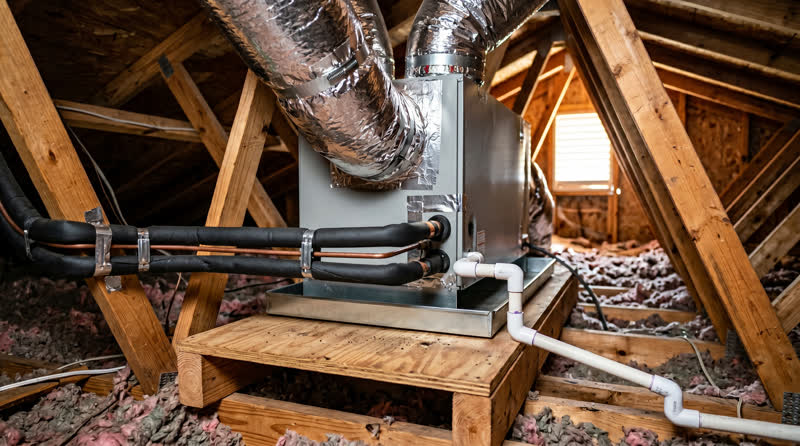
Attic air handler installations are the norm in Lakeland, FL because Florida's slab-on-grade construction leaves attics as the only viable equipment space in most homes. A properly done attic install requires four things above all else: a solid, code-compliant service platform, a secondary drain pan with a float switch, fully insulated closed-cell line sets, and a correctly routed condensate system with a primary drain, secondary drain, and emergency outlet. Get those four elements right and an attic air handler can serve a Lakeland home reliably for 15 or more years. Get even one wrong and you risk ceiling water damage, premature equipment failure, or a failed inspection that delays your project. Top Notch Air Conditioning & Heating has been doing attic installs in Lakeland and all of Polk County since 2012 — call us at (863) 875-5500 to schedule a free in-home estimate.
Why Attic Air Handlers Are Common in Florida Homes
If you have lived in other parts of the country, you may be surprised to find your air handler tucked up in the attic rather than in a basement or utility room. In Florida, this placement is not an accident — it is driven by the way Florida homes are built and the way land is used.
Florida's residential construction is almost universally slab-on-grade. There are no basements. The slab serves as the foundation, and everything from the ground up is built on it. That eliminates the most common equipment location used in northern states. Crawl spaces exist in some older Central Florida construction, but they are shallow, prone to flooding, and rarely suitable for air handler installation.
Garages are a theoretically viable equipment space, but in Lakeland's housing market they carry a real premium. A two-car garage used for HVAC equipment is a two-car garage that cannot store vehicles, and in neighborhoods like Grasslands, South Lakeland, and the newer subdivisions off Kathleen Road, homeowners increasingly refuse to surrender that square footage to HVAC. In older neighborhoods like Dixieland and Cleveland Heights, garages are often single-car or converted, leaving the attic as the default.
The result: a very large share of Lakeland's single-family homes have their air handler — the indoor unit that conditions air before distributing it through ductwork — installed in the attic above the living space. When those units age out and need replacement, they are replaced in the attic. When homeowners upgrade from a builder-grade system to a premium Carrier system, it goes back in the attic.
Heat and Humidity Challenges in Lakeland Attics
Putting an air handler in a Florida attic is not inherently problematic, but it demands a higher level of installation care than a garage or closet install. The core challenge is the environment the equipment must operate in.
Lakeland attic temperatures in summer regularly reach 130–150°F on sunny afternoons. That is not a rough estimate — it is a documented reality for unconditioned attic spaces in Central Florida. The radiant heat from the roof deck, combined with Lakeland's position in the heart of the Florida peninsula with minimal coastal breeze, creates one of the harshest equipment environments outside of industrial settings.
What does sustained 130–150°F ambient heat do to an air handler? It degrades control boards faster, shortens blower motor bearing life, stresses refrigerant line connections, and accelerates condensate pan and drain pan corrosion. Equipment that might last 18–20 years in a climate-controlled closet may see its lifespan trimmed to 12–15 years in an unconditioned Lakeland attic — unless the installation is done correctly with proper insulation around the unit and line set.
Florida's energy code requires that equipment installed in unconditioned attic spaces be surrounded by insulation that meets current R-value requirements. Ductwork serving attic-installed equipment must also be insulated to code. These are not optional best practices — they are permit requirements that a properly licensed contractor will adhere to on every install.
Humidity compounds the heat problem. Lakeland's proximity to Lake Hollingsworth, Lake Morton, Crystal Lake, and the dozens of other named water bodies surrounding the city creates persistent high ambient humidity. An air handler that is not properly sealed and insulated will sweat during operation as cool refrigerant lines contact warm, moist attic air. That condensation, if not properly managed, becomes a water damage event.
Critical Attic Install Components
A proper attic air handler installation in Lakeland involves eight specific components that every homeowner should understand before signing a contract. Cutting corners on any of these is how a new system becomes a warranty dispute six months after installation.
Properly Sized Service Platform
The air handler must rest on a solid, level platform built from 3/4-inch plywood over adequately supported joists. Florida building code requires that the platform extend far enough on all sides to allow proper service access. A flimsy OSB platform balanced on a single joist is a code violation and a safety hazard for any technician who needs to work on the unit in that 140°F attic. When we replace an attic air handler, we inspect the existing platform and rebuild it when needed — including sistering weak joists if the span requires it.
Secondary Drain Pan with Float Switch
Florida mechanical code requires a secondary drain pan beneath any attic-installed air handler, and that pan must be equipped with a float switch wired to shut down the system if the primary condensate drain fails and the pan begins to fill. This is non-negotiable in Florida — and for good reason. A flooded secondary pan in an attic will pour water directly through your ceiling drywall. The float switch turns the system off before that happens, giving you time to call for service rather than filing a homeowner's insurance claim. Any attic install without a float switch is both a code violation and an accident waiting to happen.
Line Set Insulation (Closed-Cell, Salt-Air Resistant)
The refrigerant lines running between the indoor air handler and the outdoor condenser must be fully wrapped in closed-cell foam insulation. In Lakeland's attic environment, open-cell or thin foam insulation is inadequate — it absorbs moisture, breaks down under UV and heat exposure, and allows the cold suction line to sweat, creating condensation drips inside the attic. We use closed-cell, salt-air-resistant insulation on every line set, paying particular attention to the portions of line set that run through the attic and any penetrations through the roof deck or wall. Homes near Lake Hollingsworth, Lake Morton, and the Crystal Lake area have a mild but real salt-air microclimate from the lake surfaces that can accelerate corrosion on inadequately protected line sets.
Condensate Routing (Primary, Secondary, and Emergency Outlet)
A properly installed attic air handler has three condensate pathways: the primary drain line, which routes condensate to a plumbing drain or exterior discharge under normal operation; the secondary drain line, which provides an overflow path if the primary clogs; and an emergency visible discharge outlet — typically terminating near a window or eave where a homeowner will notice a drip and know to call for service. All three lines must be pitched correctly for gravity drainage, properly supported to prevent sags that create standing water, and sized correctly for the system's condensate production rate.
Service Clearances (24-Inch Working Space Minimum)
Florida code requires a minimum 24-inch working clearance on the service side of an attic air handler. This seems obvious, but it is routinely violated on older installs where the unit was squeezed into an attic with structural constraints. Insufficient clearance means a technician cannot safely replace the blower motor, clean the evaporator coil, or swap the filter without contorting in a 140°F space. On every new install, we verify clearances before setting the unit. If the attic geometry requires repositioning the unit or modifying the platform, we do that before the equipment goes in.
Disconnect and Lighting Access
A properly wired attic air handler installation includes a local disconnect within sight of the unit — required by the National Electrical Code — and an attic light fixture near the unit to allow safe servicing. Working in a dark, hot attic with a flashlight clenched between your teeth is how technicians make mistakes. Proper lighting and a local disconnect are small details that matter for every service call the system will ever require over its lifetime.
Return Air Ducting (Sized Correctly)
Undersized return air ductwork is one of the most common sources of attic air handler problems in Lakeland. When return air flow is restricted, static pressure rises, the blower works harder, the evaporator coil temperature drops abnormally, and the system runs inefficiently and wears out faster. Return duct sizing must be calculated based on the system's airflow requirements using Manual J and Manual D calculations — not by what was there before or what fits through an existing ceiling cut.
Whip and Electrical (Correct Gauge for Distance)
The electrical whip connecting the air handler to the disconnect — and the home run wiring from the main panel to the disconnect — must be sized for both the equipment's amperage draw and the run distance. Undersized wiring causes voltage drop, which stresses the blower motor and control board. This is especially relevant in two-story homes in neighborhoods like Lakeside Village or South Lakeland where the panel may be in the garage and the disconnect in a second-floor attic, creating a longer-than-average run distance.
Carrier Equipment Options for Attic Installs
Top Notch Air Conditioning & Heating is a Carrier Factory Authorized Dealer, and we install Carrier equipment exclusively on all new system installs. This is not a casual preference — it is a deliberate decision based on equipment quality, parts availability throughout Polk County, and the warranty terms Carrier offers through its authorized dealer network.
Carrier's residential equipment is organized into three performance tiers, each with specific advantages for Lakeland attic installations:
Carrier Comfort Series (14.3 SEER2) — The entry-level Carrier tier offers solid, reliable performance for budget-conscious homeowners who want the Carrier quality baseline and the associated 10-year parts warranty. For attic installs in homes without complex zoning or humidity control needs, the Comfort series delivers excellent value.
Carrier Performance Series (15–17 SEER2) — The mid-tier Performance series adds efficiency, quieter operation, and in many models two-stage cooling that significantly improves humidity control. In Lakeland's climate, two-stage operation is particularly valuable because the system spends more time running at the lower stage, removing moisture from the air more effectively than a single-stage system that cycles on and off rapidly.
Carrier Infinity Series (17–22 SEER2) — Carrier's premium tier features variable-speed technology that continuously modulates compressor speed to match the home's exact cooling demand. For attic installs in Lakeland's higher-end homes — especially those near Lake Hollingsworth, Combee Settlement, or the Highland City corridor where homes tend to be larger and more complex — the Infinity system's precision control delivers the best long-term efficiency and comfort. The Infinity system also integrates with Carrier's smart thermostat ecosystem for remote monitoring and diagnostics.
All new Carrier installations by Top Notch Air Conditioning & Heating are backed by a 10-year parts warranty through Carrier (registration required within 90 days of installation) and a 1-year labor warranty through Top Notch. Note that these are separate warranty coverages — the 10-year parts warranty covers Carrier components; the 1-year labor warranty covers our installation workmanship.
Typical Attic AC Installation Cost in Lakeland (2026)
Installation cost for an attic air handler system in Lakeland varies by equipment tier, system tonnage, and the condition of the existing attic infrastructure. The table below reflects complete system pricing — outdoor condenser, indoor air handler, refrigerant line set, and standard installation — for a home with an existing code-compliant platform and condensate system in good condition.
| System Tier | Tonnage Range | Typical Cost Range | Notes |
|---|---|---|---|
| Carrier Comfort (14.3 SEER2) | 2–3 ton | $7,500–$10,500 | Best value entry; standard single-stage cooling |
| Carrier Performance (15–17 SEER2) | 3–4 ton | $9,500–$13,500 | Two-stage models available; improved humidity control |
| Carrier Infinity (17–22 SEER2) | 3–5 ton | $13,500–$19,500 | Variable-speed; best efficiency and comfort for larger homes |
These ranges assume the existing attic platform is serviceable, condensate lines are in good condition, and no major electrical upgrades are required. Ductwork repair or replacement, electrical panel upgrades, attic platform rebuilds, and other add-on work will increase total project cost. Call (863) 875-5500 for a free in-home estimate specific to your home.
Attic Install Add-On Costs to Plan For
Many Lakeland attic installs involve more than a straight equipment swap. When a system has been running for 12–15 years, the supporting infrastructure — drain pans, platforms, line sets, condensate pumps — often needs attention at the same time. Below are the most common add-ons and their typical cost ranges in the Lakeland market as of 2026.
| Add-On | Typical Range | When You Need It |
|---|---|---|
| Secondary drain pan replacement | $385–$950 | Rusted, cracked, or missing pan; no float switch present |
| Return duct upgrade | $450–$1,200 | Undersized return causing high static pressure or poor airflow |
| Platform rebuild | $325–$750 | Rotted plywood, unsupported joists, inadequate service clearance |
| Line set replacement | $625–$1,450 | Damaged, undersized, or uninsulated existing copper line set |
| Condensate pump | $320–$525 | Attic drain cannot gravity-flow to an exterior or plumbing outlet |
| Surge protector | $185–$450 | Recommended for all Lakeland installs given summer lightning frequency |
| Attic catwalk extension | $200–$650 | No safe walking path to unit from attic access hatch |
Why Lakeland Attic Conditions Demand Extra Care
Lakeland is not a generic Florida market when it comes to attic AC installation — the city's specific geography and housing patterns create conditions that require above-average attention to installation detail.
The neighborhoods around Lake Hollingsworth and Lake Morton sit on some of the most waterfront-adjacent residential land in Central Florida. Homes in these areas experience a mild but real lake-air effect that accelerates corrosion on metal components and condensate drainage hardware. Line sets on these homes must be especially well-sealed and insulated. Similarly, homes in the Crystal Lake area and along the western shore near Medulla see elevated ambient moisture that shortens the service life of inadequately protected equipment.
The historic districts of Dixieland and the neighborhoods surrounding Lake Morton present a different challenge: these older homes often have attic structures that were never designed to hold modern air handling equipment. Joists are spaced for older, lighter materials. Access hatches may be original — narrow, low-clearance openings that require creative rigging to get a modern air handler into position. Our crews have navigated these installs hundreds of times and know how to work in tight historic attic spaces without damaging original ceiling plaster or trim.
In South Lakeland, Lakeside Village, Kathleen, and Combee Settlement, the housing stock skews newer — 1990s through 2010s — and attic structures are generally more installation-friendly. However, these homes often have larger floor plans that require larger-tonnage systems, and attic spans are wider, which can create platform support challenges that smaller homes do not face.
Cleveland Heights, Grasslands, and Highland City homeowners frequently contend with a Florida-specific concern that does not get enough attention: hurricane-prep tie-downs for attic air handlers. During a named storm, an improperly secured attic air handler can shift on its platform, stressing refrigerant connections and potentially rupturing a condensate line. Top Notch Air Conditioning & Heating uses proper equipment strapping on all new attic installs — a detail that adds minimal cost but significant protection during Florida's active storm season.
Summer storms are another critical factor throughout all of Lakeland. The city averages over 100 thunderstorm days per year. Lightning-induced power surges are a leading cause of premature control board and compressor failure for both attic and ground-level systems. A properly installed surge protector on the unit is one of the most cost-effective protective investments a Lakeland homeowner can make — and we recommend it on every install regardless of equipment tier.
How Top Notch Handles Attic Installs
Top Notch Air Conditioning & Heating follows a consistent eight-step process for every attic AC installation in Lakeland. This process is not a sales pitch — it is how we protect both the homeowner's investment and our own workmanship warranty.
- Manual J Load Calculation. We calculate the home's actual heating and cooling load using Manual J methodology — accounting for square footage, ceiling height, insulation levels, window area, orientation, and local climate data. This determines the correct system tonnage. Oversizing is just as harmful as undersizing in a Lakeland attic install.
- Equipment Selection. Based on the load calculation, we recommend the appropriate Carrier system tier and tonnage. We present options at the Comfort, Performance, and Infinity tiers so the homeowner can make an informed decision balancing upfront cost, efficiency, and long-term operating cost.
- Permit Pulled. We pull the mechanical permit from the Polk County Building Division before any work begins. No permit means no final inspection — and no final inspection means no proof of code-compliant installation if you ever sell the home or file an insurance claim.
- Attic Prep. Before the old unit comes out, we inspect the platform, condensate infrastructure, line set condition, and electrical. Any deficiencies are addressed before the new equipment goes in — not as an afterthought once the new unit is already sitting on an inadequate platform.
- Removal of Old Unit. The existing air handler is properly decommissioned, refrigerant is recovered by our EPA 608-certified technicians, and the old equipment is removed from the attic and disposed of responsibly.
- New System Installation. The new Carrier air handler is set on the prepared platform, connected to the line set, condensate system, return and supply ducts, electrical whip, and disconnect. Every connection point is verified before startup.
- Commissioning. We start the system, verify refrigerant charge using manufacturer-specified superheat and subcooling targets, confirm airflow at each register, test the float switch, verify condensate flow through all three drain pathways, and record all startup readings for the job file.
- Final Inspection. The Polk County inspector conducts the final mechanical inspection. We coordinate the inspection schedule and meet the inspector on-site. The homeowner receives a copy of the passed inspection report.
Top Notch Air Conditioning & Heating holds Florida license CAC1817537. We are located at 164 Spirit Lake Rd, Winter Haven, FL 33880, open Monday through Saturday, 8 AM to 5 PM, closed Sundays. We have been serving Lakeland and all of Polk County since 2012. Call us at (863) 875-5500 to schedule your free in-home estimate.
The Yeti Club for Attic Systems
Because attic air handlers operate in a harsh environment and access requires a ladder and attic entry, annual professional maintenance is not optional — it is how you protect the significant investment a new system represents. Top Notch Air Conditioning & Heating's Yeti Club is built precisely for this.
At $199 per year per system, the Yeti Club includes:
- One annual tune-up per system — especially valuable for attic units because the access, inspection thoroughness, and time required to service an attic air handler mean you want a trained technician doing it every year, not skipping years to save money
- Condensate drain line flush — Lakeland's algae-friendly climate means drain lines clog faster than in most markets; annual flushing keeps primary and secondary drains clear
- Float switch test — the float switch is your primary protection against attic water damage; we verify it trips at the correct water level every year
- Refrigerant pressure check — attic environments can stress refrigerant connections; annual pressure verification catches small leaks before they become large ones
- 10% off repairs — if any repair is identified during the tune-up or at any point during your membership year, members receive 10% off the repair cost
- Priority scheduling — Yeti Club members move to the front of the scheduling queue during peak summer demand, when Lakeland HVAC companies are at maximum workload
The standard service call fee of $99 applies to all service visits, including Yeti Club member visits. The fee is never reduced or eliminated for members. The Yeti Club's value is in the annual tune-up, drain maintenance, float switch testing, repair discounts, and priority scheduling. To enroll or learn more, ask when you call (863) 875-5500 or visit our AC maintenance page.
When to Call Top Notch
Frequently Asked Questions About Attic AC Installation in Lakeland
Is an attic AC installation more expensive than a garage or closet install?
Generally yes, by $300–$800 on average, due to the additional labor involved in working in a confined, high-heat attic space and the code requirements for secondary drain pans, float switches, and platform construction. However, the primary cost driver is equipment tier and tonnage — not the location of the install. If the existing attic infrastructure (platform, condensate, electrical) is in good condition, the attic premium is modest. If infrastructure repairs are needed, those add-on costs apply regardless of whether the unit is going in a garage or an attic.
How long do attic air handlers last in Florida?
With a proper installation and annual maintenance, a Carrier attic air handler in a Lakeland home should last 15–18 years. The attic environment does accelerate wear compared to a climate-controlled equipment space, which is why correct insulation, sealed condensate routing, and annual professional maintenance — including refrigerant pressure checks and float switch tests — are so important. Systems that are improperly installed or never maintained in a Florida attic may fail in 8–12 years.
Do I need a secondary drain pan for an attic install in Lakeland?
Yes. Florida mechanical code requires a secondary drain pan with a float switch for any air handler installed in an attic or other location where a condensate overflow could cause property damage. This is not optional or a regional best practice — it is a code requirement enforced at final inspection in Polk County. Any installation quote for an attic air handler in Lakeland that does not include a secondary drain pan and float switch is either a code violation in progress or the cost is hidden elsewhere in the estimate.
Will an attic install make my electric bill higher?
Not if the installation is done correctly. The attic location itself does not increase operating cost — the air handler is inside the insulated duct system regardless of where it sits. What can increase operating cost is inadequate insulation around the unit and line set, which allows heat gain into the refrigerant circuit, or undersized return ductwork that forces the blower to work harder than needed. A properly installed and insulated attic air handler paired with a correctly sized system operates at the same efficiency as the same unit installed in a garage.
Can I convert from an attic install to a garage install?
Yes, though it is a significant project that typically adds $1,500–$3,500 to the cost of the replacement compared to a straight attic swap. Moving from an attic to a garage location requires rerouting all supply and return ductwork, relocating the line set, re-engineering the condensate drain routing, and updating the electrical disconnect location. For most Lakeland homeowners, the attic-to-garage conversion makes economic sense only when the home is already undergoing a larger renovation or when the attic structure has severe access or structural problems that make continued attic installation impractical.