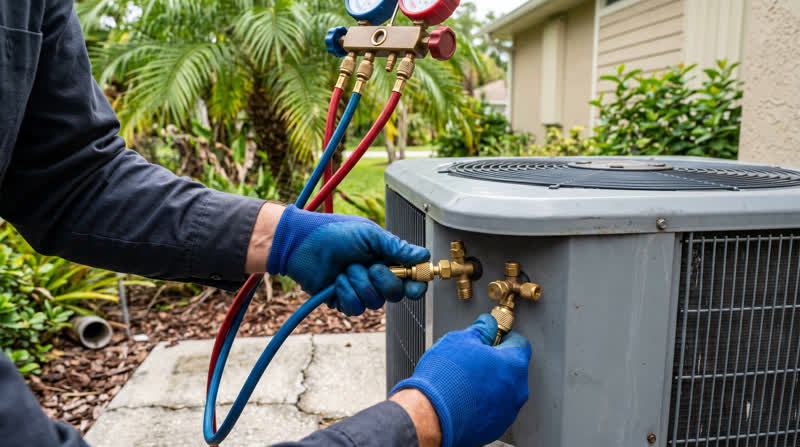
Quick Answer
Signs of a refrigerant leak include warm air from vents despite the system running, ice on refrigerant lines, a hissing or bubbling sound near the system, higher-than-usual electric bills, and the system running continuously without reaching your temperature setpoint. Refrigerant leak repair in Winter Haven costs $350 to $1,500+ depending on leak location, refrigerant type, and amount needed. The leak must be found and repaired — not just recharged.
Refrigerant leak is one of the most misunderstood AC problems. Many homeowners are told their system "needs a Freon recharge" without ever being told where the Freon went. Refrigerant does not get used up like fuel — a properly sealed system should hold the same refrigerant charge for its entire lifespan of 15 to 20 years. If it's low, there's a leak, and simply topping it off without repairing the leak is an expensive temporary fix.
In Winter Haven's climate, a refrigerant leak hits harder than it would elsewhere. The system has to work harder on days when it's 93 degrees with 80% humidity. Running with low refrigerant under those conditions accelerates wear on the compressor, the most expensive component in the system. Here's everything you need to know.
How Refrigerant Works
Refrigerant circulates in a closed loop between the indoor evaporator coil and the outdoor condenser coil. At the evaporator coil (inside your home), refrigerant absorbs heat from the air — this is what makes the air cold. At the condenser coil (outside), the refrigerant releases that heat to the outside air. This cycle repeats hundreds of times per day.
When refrigerant is low, the evaporator coil doesn't get cold enough to absorb heat effectively. The air passing over it doesn't cool properly. The system runs longer and harder trying to compensate, drawing more electricity and stressing the compressor.
Signs of a Refrigerant Leak in Your Winter Haven Home
- Warm or cool-but-not-cold air from vents: Supply air feels 65 to 70 degrees instead of the normal 54 to 60 degrees
- System runs continuously without reaching setpoint: The thermostat calls for 74 degrees but the house hovers at 79 or 80
- Ice on the refrigerant lines or indoor unit: Visible frost or ice on the copper pipes near the air handler
- Hissing or bubbling sounds: Escaping refrigerant under pressure creates a hissing sound; moisture in the line creates a bubbling sound
- Higher electric bills: A system running at reduced efficiency works harder and costs more to operate
- Humidity problems: Low refrigerant reduces the coil's ability to dehumidify, leaving the home feeling clammy
Where Refrigerant Leaks Occur
Leaks develop at specific points in the refrigerant circuit, each requiring different repair approaches:
| Leak Location | Typical Cause | Repair Approach |
|---|---|---|
| Evaporator coil (indoor) | Formicary corrosion from VOCs in home air | Coil replacement or coil sealing if minor |
| Condenser coil (outdoor) | Physical damage, corrosion from salt air | Coil repair or replacement |
| Schrader valves (service ports) | Valve core wear or improper servicing | Valve core replacement (inexpensive) |
| Flare connections | Vibration loosening connections over time | Tighten or re-flare connection |
| Refrigerant line sets | Physical damage, rubbing against structure | Line repair or replacement |
Formicary Corrosion: A Florida-Specific Problem
Winter Haven homes with off-gassing materials — certain cleaning products, building materials, and flooring adhesives — can produce volatile organic compounds (VOCs) that create formicary (ant-like pitting) corrosion on copper evaporator coils. This form of corrosion is responsible for a significant portion of evaporator coil refrigerant leaks in Florida residential systems, particularly in newer homes with high indoor VOC concentrations.
The corrosion creates tiny pinhole leaks in the copper coil that are difficult to detect without specialized equipment. If your home smells of indoor VOCs (new carpet, fresh paint, cleaning chemicals) and you have a refrigerant leak, ask your technician to check for formicary corrosion. Installing an electronic air purifier or UV system can reduce VOC levels and prevent recurrence after coil replacement.
Refrigerant Types and Cost Impact
What your system uses significantly affects repair cost:
- R-410A: Standard refrigerant in systems installed 2010 to 2025. Currently available and reasonably priced. A recharge after leak repair typically costs $250 to $500 depending on the amount needed.
- R-22 (Freon): Used in systems installed before 2010. Phased out of production by EPA mandate. Available only from recycled stocks at significantly elevated prices — $600 to $1,500 or more for a recharge. If you have an R-22 system with a significant leak, full system replacement is almost always the financially sound choice.
- R-454B / R-32: Newer refrigerants appearing in systems installed after 2025 as R-410A is phased down. Lower global warming potential than R-410A.
What Leak Detection Involves
Modern leak detection uses several methods:
- Electronic leak detector: A handheld device that detects refrigerant vapor; effective for locating leak areas
- UV dye: A fluorescent dye injected into the system that glows under UV light at leak points
- Nitrogen pressure test: The system is pressurized with nitrogen and monitored for pressure drop; pinpoints leaks precisely
- Bubble solution: Applied to suspect connection points; bubbles indicate escaping gas
A thorough leak search is typically included in the refrigerant service charge or charged separately as a diagnostic. Don't accept a recharge without documentation of the leak location and how it was repaired.
Total Cost of Refrigerant Leak Repair in Winter Haven
The total cost depends on what's leaking and how much refrigerant needs to be replaced:
- Schrader valve replacement + R-410A recharge: $200 to $400
- Flare connection repair + R-410A recharge: $250 to $500
- Evaporator coil sealing (if eligible) + R-410A recharge: $400 to $700
- Evaporator coil replacement + R-410A recharge: $1,000 to $2,200
- R-22 recharge without repair (not recommended): $600 to $1,500+
Top Notch Air Conditioning & Heating provides written estimates that break out labor, parts, and refrigerant costs separately. If the repair cost approaches the system replacement cost — especially on older systems — we'll tell you honestly so you can make an informed decision.
Frequently Asked Questions
Is a refrigerant leak dangerous to my health?
Modern refrigerants like R-410A and R-22 are not acutely toxic at the concentrations that occur from residential AC leaks, but they are asphyxiants in enclosed spaces. In a well-ventilated home, a slow refrigerant leak does not pose a direct health risk. However, larger leaks in enclosed mechanical rooms or attic spaces can displace oxygen. If you smell a chemical odor near your AC system, ventilate the area and call for service.
How long does refrigerant leak repair take?
A minor leak repair at a valve or connection followed by recharge can be completed same-day in 2 to 3 hours. Evaporator coil replacement requires refrigerant recovery, coil replacement, system evacuation, and recharge — typically a 4 to 6 hour job that may be completed same-day or require a follow-up appointment depending on parts availability. Top Notch Air Conditioning & Heating will give you a time estimate before work begins.
Get Your Refrigerant Leak Properly Diagnosed and Repaired
Refrigerant leaks don't get better on their own. Every day a system operates low on refrigerant, the compressor works under stress and accumulates wear. In Winter Haven's summer climate, that compressor stress happens at maximum load. Call Top Notch Air Conditioning & Heating at (863) 875-5500 for proper leak detection and repair — not just a temporary recharge. We're a Carrier Factory Authorized Dealer serving Winter Haven and all of Polk County since 2012, license CAC1817537.