Quick Answer
Most AC noises trace back to one of three root causes: electrical problems (buzzing, humming), mechanical wear (screeching, banging, rattling), or refrigerant and drain issues (hissing, bubbling, gurgling). Some sounds — a high-pitched refrigerant hiss, a loud bang inside the cabinet, or buzzing accompanied by the smell of burning — mean you should turn the system off immediately and call for AC repair. Others, like a low hum on startup or a brief click when the thermostat signals a cycle, are completely normal. This guide covers every common AC noise, what it typically indicates, when it is an emergency, and what repairs cost in Polk County in 2026.
Your air conditioner has been running quietly for years, and then one afternoon you hear something new — a buzzing from the outdoor unit, a screech from the air handler, or a rhythmic banging that was not there last week. For Lakeland, FL homeowners, unfamiliar sounds are always worth investigating quickly. Florida's heat means your AC works 10 to 12 months per year, and small problems turn into expensive failures faster here than almost anywhere else in the country.
Top Notch Air Conditioning & Heating has been diagnosing AC noises throughout Polk County since 2012. This guide reflects what our technicians hear on real service calls every week. Call us at (863) 875-5500 Monday through Saturday, 8 AM to 5 PM, if you need a professional diagnosis.
Normal vs. Abnormal AC Sounds
Not every noise from your air conditioner signals a problem. Knowing which sounds are expected helps you avoid unnecessary alarm — and helps you recognize the ones that actually deserve attention.
Sounds that are normal: A gentle whoosh of air from supply vents when a cycle starts. A soft fan hum from the air handler or outdoor unit during normal operation. A single click when the thermostat calls for cooling and the contactor closes. A brief gurgle in the condensate drain line as water empties at the end of a cycle. A low-frequency hum from the compressor during operation — consistent, steady, and quiet.
Sounds that are warning signs: Any buzzing, humming, screeching, rattling, banging, or hissing that is new, getting louder, or accompanied by reduced cooling. Sounds that change with outdoor temperature (louder on hot afternoons) often point to electrical components under thermal stress. Sounds that appear only at startup and then fade can indicate a struggling compressor or failing capacitor. Any smell — burning plastic, sulfur, or refrigerant — that accompanies a noise is an immediate shutdown trigger.
Buzzing
Buzzing is one of the most common AC noise complaints in Lakeland. It can originate from the outdoor condenser unit or the indoor air handler, and it covers a wide range of underlying problems — from minor (loose panel) to serious (refrigerant leak). Isolating where the buzz comes from is the first diagnostic step.
Failing Capacitor (60 Hz Electrical Buzz at Outdoor Unit)
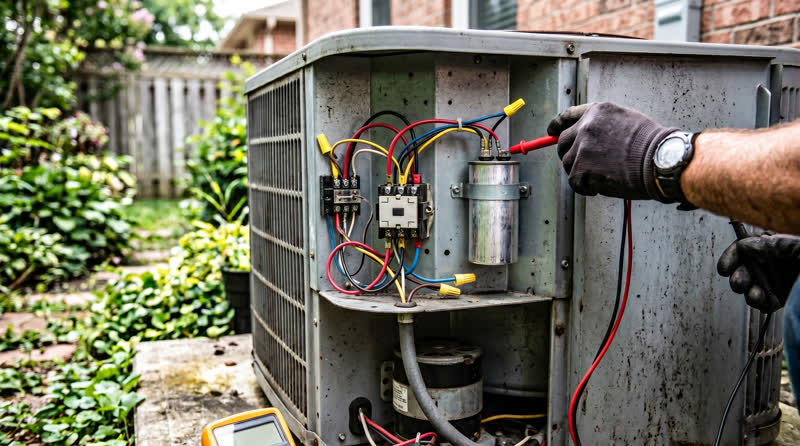
A capacitor stores and releases the electrical charge needed to start the compressor and condenser fan motors. As it weakens, it begins to emit a characteristic 60 Hz electrical buzz — a low, steady hum with a slight electrical quality to it. You may hear this at the outdoor unit just before or after a startup attempt. In Lakeland's climate, capacitors fail more often than in any northern state because the combination of high ambient heat and near-constant operation degrades them rapidly. A failing capacitor almost always trips the system into a no-start condition within days of first showing symptoms.
Loose Contactor or Relay
The contactor is an electromagnetic switch that connects utility power to the compressor and condenser fan when the thermostat calls for cooling. A worn or pitted contactor can buzz loudly during operation — sometimes mistaken for an electrical short. The chattering comes from the contact surfaces not closing cleanly. A loose relay inside the air handler control board can produce a similar buzz from the indoor unit. Both are straightforward replacements for a licensed technician.
Refrigerant Leak (High-Pitched Buzz)
A refrigerant leak under high pressure can produce a buzzing or hissing sound with a higher pitch than electrical buzzing. If the buzz seems to be coming from the refrigerant lines near the outdoor unit or from the evaporator coil in the air handler, and your system is also losing cooling capacity, a leak is the likely culprit. Refrigerant leak detection and repair in Polk County typically costs $400–$1,200 depending on leak location and refrigerant type.
Loose Panel or Fan Blade
Not all buzzing is electrical. A vibrating access panel on the outdoor unit, a loose fastener on the air handler cabinet, or a fan blade that has slipped slightly out of balance can all create a buzzing or rattling vibration that sounds electrical but is actually mechanical. This is a DIY-friendly inspection: turn the system off, check that all access panels are secured, and look for any visible loose screws. If the buzz disappears after tightening a panel, you have solved it.
When to Shut It Off
Turn the system off at the thermostat and the disconnect immediately if you notice: a burning plastic or electrical smell alongside the buzzing; visible arcing or sparks near the outdoor disconnect or air handler; a buzzing that escalates rapidly in volume; or the circuit breaker tripping repeatedly. Call (863) 875-5500 before attempting to restart the system — these symptoms point to electrical failure that can damage the compressor, control board, or wiring.
Humming
Humming differs from buzzing in that it is typically lower-pitched and more consistent. A hum that is always present during operation may be normal; a hum that has changed in character, grown louder, or appears only at startup points to a specific failure mode.
Compressor Lockout / Hard Start
When a compressor struggles to start — due to low voltage, a weakened capacitor, or internal wear — it draws heavy current and produces a loud, strained hum for a few seconds before either successfully starting or cutting out on thermal protection. This is called a hard start. A hard-start kit can provide extra torque to help a struggling compressor, but it is a temporary measure; a compressor that consistently hard-starts needs professional evaluation before it fails completely.
Stuck Contactor
A contactor that fails in the closed position keeps power applied to the compressor and condenser fan continuously, even when the thermostat is not calling for cooling. The system runs nonstop and the outdoor unit hums even after you raise the thermostat setpoint. This is both an efficiency problem and a mechanical wear problem — the compressor is not designed to run without pause. Turn off the system at the disconnect and call for service.
Failing Motor (Blower or Fan)
Both the blower motor (inside the air handler) and the condenser fan motor (outdoor unit) produce a characteristic low hum during normal operation. As bearings wear, that hum grows louder and develops an uneven, grinding quality. If the hum from either motor is noticeably louder than it was six months ago, the bearings are wearing. Blower motor replacement in Polk County runs $650–$1,100; condenser fan motor replacement runs $475–$895.
Normal vs. Abnormal Hum
A normal compressor hum is consistent and quiet — background noise you would only notice in a silent room with the system running. An abnormal hum is louder than the fan sound, has a strained quality, varies in pitch, or is accompanied by vibration you can feel on the cabinet. When in doubt, a technician can measure running current and compare it to nameplate ratings to determine whether a motor is healthy or struggling.
Screeching, Squealing, or High-Pitched Sounds
High-pitched sounds from an AC system are among the most alarming — and with good reason. Some indicate mechanical wear that can wait a day or two for a service call; one specific scenario requires immediate shutdown.
Failing Blower Bearing
The blower wheel inside your air handler spins on a shaft supported by bearings. As those bearings dry out or wear, they produce a squealing or screeching sound that escalates over days to weeks. In some cases, adding lubrication to the bearing port extends motor life; in others, bearing failure has progressed to the point where motor replacement is the only repair. Either way, continuing to run a squealing blower risks a seized motor that can overheat and damage the control board.
Belt Slip (Older Units Only)
Belt-driven blower systems were common in systems installed before the mid-1990s. If your home in Dixieland, Lake Morton, or Cleveland Heights has original equipment from that era, a worn or glazed belt can produce a squealing sound identical to a car's slipping alternator belt. Most modern Carrier systems — including all equipment Top Notch Air Conditioning & Heating installs — use direct-drive motors with no belt, so this cause applies only to older equipment. Belt replacement is inexpensive.
Refrigerant Pressure Relief — Turn Off Immediately
This is the one high-pitched sound that is a genuine safety emergency: a sustained, very loud screech or whistle coming from the outdoor unit, sometimes accompanied by a hissing or rushing-air sound. This indicates refrigerant escaping under high pressure through a relief valve or significant leak point. Turn the system off at the thermostat immediately. Refrigerant under pressure can cause serious injury, and continuing to operate the system risks catastrophic compressor damage. Call (863) 875-5500 — this is not a wait-and-see situation.
Clicking, Tapping, or Rattling
Clicking and tapping cover a range of causes from completely normal to moderately urgent. Rattling almost always indicates something is physically loose — either debris or a mechanical fastener.
Normal Startup Click
A single, clean click when the system starts or stops is the sound of the contactor opening or closing. It is a normal, healthy electrical sound. If you hear only one click at the beginning of each cycle and one at the end, nothing is wrong. Repeated clicking at startup — five, ten, fifteen clicks before the system catches — is abnormal and usually indicates a failing capacitor or a struggling compressor.
Loose Debris in Fan Blades
A rhythmic tapping or clicking during operation — especially if it speeds up as the fan accelerates — usually means a twig, leaf, or small object has entered the outdoor condenser cabinet and is contacting a fan blade on every rotation. Turn the system off at the disconnect, remove the top grille (most Carrier condensers have accessible top grilles), and remove any debris. Never reach into the unit while power is applied. This is one of the most common calls after summer thunderstorms, which are frequent throughout Lakeland, Combee Settlement, and Kathleen neighborhoods.
Failing Thermostat
A thermostat that is losing its ability to hold a contact reliably can produce repeated clicking sounds — sometimes rapid bursts — as it attempts to signal a cooling call. This can also manifest as short-cycling, where the system starts and stops every few minutes. If clicking seems to originate from the thermostat location rather than the equipment, try replacing the thermostat batteries first. If the behavior continues, thermostat replacement may be needed.
Loose Mounting Hardware
Outdoor condenser units are mounted on pads and secured with bolts through the unit feet. Over years of vibration — especially on the poorly-draining soil found around Crystal Lake, Lake Hollingsworth, and other low-lying Lakeland areas — these mounts can loosen. A rattling that intensifies during compressor startup and fades once the unit reaches steady-state operation often points to loose mounting hardware or a compressor mounting isolator that has cracked. Tightening the unit feet or replacing rubber isolators stops the noise.
Banging, Clanking, or Knocking
Loud mechanical banging from an AC system is always an urgent noise. These sounds indicate that something is physically failing or has already failed inside the equipment. Do not ignore them.
Failed Compressor Mounts
The compressor inside the outdoor unit sits on rubber mounting isolators that absorb vibration. When those mounts crack or deteriorate — accelerated by Lakeland's heat and the moisture swings between summer storms and dry spells — the compressor begins to knock against the cabinet walls during startup and shutdown. The sound is a dull, heavy thud. If the mounts have failed recently, replacing them may restore quiet operation; if the compressor itself is worn, the noise will persist.
Foreign Object in Fan
A large object — a section of bark blown in during a Lakeland thunderstorm, a child's toy near the outdoor unit, or accumulated debris — can lodge in the condenser fan blades and produce a violent clanking or banging sound. Turn the system off at the disconnect immediately. Running the fan against an obstruction will bend or crack the blades, requiring fan replacement at $475–$895 for the full motor and blade assembly.
Refrigerant Slugging
Refrigerant slugging occurs when liquid refrigerant enters the compressor — which is designed to compress gas only. The result is a rhythmic knocking sound from the compressor, sometimes called liquid hammer. Common causes include a failed expansion valve, refrigerant overcharge, or extended shutdown in cold conditions that allows refrigerant to pool. This requires immediate professional diagnosis; compressor failure from slugging is expensive at $1,850–$3,450 for replacement, or $7,500 and above for a full system replacement.
Bent Blower Wheel
The blower wheel inside the air handler can become unbalanced if a blade is bent by debris or if accumulated dirt on one section creates an imbalance. The resulting noise is a rhythmic thumping or banging from inside the air handler cabinet — louder than normal blower vibration and present throughout the entire cycle. Blower wheel replacement is often combined with blower motor replacement; total cost runs $650–$1,100.
Hissing, Bubbling, or Gurgling
Hissing and gurgling sounds have two very different origins — one is a serious refrigerant problem, and the other is usually a minor drain issue. Location and character of the sound help distinguish them.
Refrigerant Leak (Active Hiss)
A steady hiss from the refrigerant lines, outdoor unit, or indoor air handler — especially if accompanied by ice on the refrigerant lines or gradual loss of cooling — indicates an active refrigerant leak. This is distinct from the emergency pressure-relief screech described earlier; it is quieter and more like the sound of air slowly escaping a tire. It still requires prompt service. Running a system with a refrigerant leak does not fix itself, and continuing to operate it damages the compressor from low suction pressure. Call (863) 875-5500 for leak detection and repair.
Drain Line Gurgle (Blocked or Improperly Sloped)
A gurgling from the indoor air handler — typically at the end of a cooling cycle when the condensate pump or drain empties — is usually benign if it is brief and consistent. A persistent gurgle throughout the cycle, or a gurgle accompanied by water pooling near the air handler, indicates a partially blocked drain line. In Lakeland's humidity, algae grows in drain lines quickly; homeowners in South Lakeland, Grasslands, and Lakeside Village commonly need drain line service once a year or more as conditions dictate. A slow gurgle now can become a full blockage and ceiling water stain within weeks.
Expansion Valve Flutter
The thermostatic expansion valve (TXV or TEV) meters refrigerant flow into the evaporator coil. When it begins to fail, it can produce a hissing or fluttering sound as it opens and closes erratically. This is often accompanied by temperature swings — the system over-cools briefly, then undershoots. TXV replacement requires a licensed refrigerant technician and is typically bundled with a system check and leak verification.
Quick Diagnostic Reference
| Sound | Most Likely Cause | Urgency | Safe DIY Check | Pro Action |
|---|---|---|---|---|
| Electrical buzz (outdoor unit) | Failing capacitor or loose contactor | Schedule within 1–2 days | Note if sound changes at startup vs. runtime | Capacitor test and replacement |
| High-pitched buzz + reduced cooling | Refrigerant leak | Schedule within 2–3 days | Check refrigerant line for frost or ice | Leak detection and repair, recharge |
| Buzz + burning smell or sparks | Electrical failure | Turn off immediately | None — do not restart | Electrical diagnosis, wiring/board repair |
| Low steady hum at startup (won't run) | Hard-start / failed capacitor | Same day or next day | Check breaker, confirm power to unit | Capacitor replacement or hard-start kit |
| Loud screech from outdoor unit | Refrigerant pressure relief | Turn off immediately | None — evacuate area | Refrigerant system inspection and repair |
| Squealing from air handler | Blower bearing or belt | Schedule within 1–3 days | Note if louder at startup or continuous | Lubrication or motor/belt replacement |
| Rhythmic clicking or tapping | Debris in condenser fan | Turn off, inspect | Power off; remove top grille; clear debris | Fan blade inspection and replacement if bent |
| Repeated clicking at startup | Failing capacitor or thermostat | Schedule within 1–2 days | Replace thermostat batteries | Capacitor or thermostat diagnosis |
| Heavy banging or knocking | Foreign object, failed mounts, slugging | Turn off; call same day | Visual check around outdoor unit for debris | Full mechanical inspection |
| Steady hiss from refrigerant lines | Refrigerant leak | Schedule within 2 days | Feel for frost on suction line | Leak detection, repair, recharge |
| Gurgling from air handler | Drain line partial blockage | Schedule within 1 week | Check drain pan for standing water | Drain line clearing and treatment |
Repair Cost Reference (Polk County 2026)
| Repair | Typical Cost | Notes |
|---|---|---|
| Capacitor replacement | $175–$325 | Most common repair in Polk County; straightforward labor |
| Contactor replacement | $185–$345 | Often replaced alongside capacitor when both show wear |
| Blower motor replacement | $650–$1,100 | Includes motor, wheel, and labor; variable-speed motors cost more |
| Condenser fan motor replacement | $475–$895 | Includes blade assembly; higher end for larger tonnage systems |
| Compressor replacement | $1,850–$3,450 | Labor-intensive; full system replacement often considered at this price point |
| Full system replacement | $7,500 and above | Carrier equipment; cost varies by tonnage, SEER, and installation complexity |
| Refrigerant leak find and repair | $400–$1,200 | Includes electronic leak detection, repair, and recharge; R-410A vs. R-32 affects cost |
| Drain line clearing | $150–$275 | Includes flush, vacuum, and algaecide treatment |
All pricing is for residential equipment in Polk County and reflects 2026 labor and parts costs. Top Notch Air Conditioning & Heating provides written upfront estimates before any work begins. Call (863) 875-5500 for a same-day diagnostic appointment.
Why Lakeland's Climate Accelerates AC Wear and Noises
Lakeland sits in one of the most AC-intensive climates in the continental United States. The combination of relentless summer heat, persistent humidity from the city's dozens of lakes, and a long thunderstorm season creates conditions that wear out AC components faster than in almost any other region. Understanding these factors helps explain why noises that might be years away in a northern climate can appear in just a season or two here.
Humidity and corrosion: Polk County's average relative humidity hovers above 70% for most of the year. This moisture accelerates corrosion of copper refrigerant lines, evaporator coil fins, and electrical contacts. Homes near Lake Hollingsworth, Lake Morton, and Crystal Lake — where surface water keeps the air especially humid — see accelerated coil and contact corrosion. Salt-air carry from Gulf storms adds a secondary corrosion mechanism that affects aluminum components in outdoor units across neighborhoods from Dixieland to Highland City.
Thunderstorm power surges: Lakeland averages over 100 thunderstorm days per year — one of the highest totals in the U.S. Each lightning strike nearby can deliver a voltage spike that stresses capacitors, contactors, and control boards even if a whole-home surge protector is present. Homeowners in Combee Settlement, Medulla, and Kathleen — areas with longer utility runs from substations — sometimes see more frequent surge-related failures. Post-storm electrical buzzing is one of the most common next-day calls Top Notch Air Conditioning & Heating receives throughout Lakeland.
Heat loading and continuous operation: Unlike northern climates where AC systems run seasonally and enjoy months of rest each year, Lakeland systems run essentially year-round. A 10-year-old system in Grasslands or Lakeside Village has accumulated operating hours equivalent to a 20-year-old system in a cooler climate. Bearings, capacitors, contactors, and compressor valves all hit end-of-life sooner. This is why the noises described in this guide tend to appear earlier in a system's chronological age in Lakeland than manufacturers' typical lifespans suggest.
Dust and pollen loading: Central Florida's oak and pine pollen seasons are intense, and the fine particulate load on outdoor condenser coils reduces airflow efficiency and increases compressor operating temperatures. Higher compressor temperatures accelerate capacitor degradation and increase the likelihood of compressor overheating — both of which show up first as the buzzing, humming, and hard-start symptoms described earlier. South Lakeland and Cleveland Heights residents with dense tree canopy overhead see notably higher coil fouling rates.
When to Turn the System Off vs. When to Schedule a Service Call
Turn the system off at the thermostat (and the outdoor disconnect) immediately if you experience any of these:
- Burning plastic, electrical, or chemical smell accompanying any noise
- Visible sparks or arcing near the disconnect box or air handler
- A loud sustained screech or whistle from the outdoor unit (refrigerant pressure release)
- A violent banging or clanking that is getting louder with each cycle
Schedule a service call within 1–3 days (system can continue operating) if you notice:
- A new low-level buzz from the outdoor unit that does not change cooling performance
- A squealing from the air handler that is consistent but not escalating
- Repeated clicking at startup (more than 3–4 clicks before system catches)
- A persistent gurgle from the air handler drain line with no visible water pooling
How Top Notch Diagnoses AC Noises
Top Notch Air Conditioning & Heating uses a structured six-step diagnostic process on every noise complaint to make sure the underlying cause — not just the symptom — is correctly identified before any repair is recommended.
- Technician intake call: Before the visit, our service coordinator asks you to describe the sound, when it started, where it seems to come from, and whether cooling performance has changed. This helps the technician arrive with the most likely replacement parts already on the truck.
- Visual inspection of outdoor and indoor units: The technician checks for visible damage, debris, frost, oil stains (refrigerant leak indicator), and loose panels before powering up the system.
- Electrical measurement: Running amperage on the compressor and fan motors is compared to nameplate ratings. Capacitor microfarad readings are tested with a calibrated meter. Abnormal readings often explain noise before the noise is even reproduced.
- Operational test and noise localization: The system is run through a full cycle while the technician listens with the cabinet panels removed. Noise location, character, and timing within the cycle are documented.
- Refrigerant pressure check: Suction and discharge pressures are measured and compared to manufacturer specifications for the current outdoor temperature. Abnormal pressures point to leaks, TXV failure, or compressor valve issues.
- Written estimate and options: You receive a written estimate with all repair options and associated costs before any work begins. No surprises, no pressure — just clear information so you can make the right decision for your home and budget.
As a Carrier Factory Authorized Dealer, Top Notch Air Conditioning & Heating technicians receive factory training on Carrier diagnostic procedures and have access to Carrier technical support. All repairs come with a 1-year labor warranty. Carrier equipment replaced or installed on covered units carries Carrier's 10-year parts warranty separately. Our license number is CAC1817537, verifiable at MyFloridaLicense.com. Find us at 164 Spirit Lake Rd, Winter Haven, FL, open Monday through Saturday, 8 AM to 5 PM, closed Sundays.
Yeti Club for Catching Noises Before They Become Failures
The Yeti Club is Top Notch Air Conditioning & Heating's annual maintenance plan, designed specifically for Florida homeowners who want to stay ahead of the breakdowns that Lakeland's demanding climate accelerates. At $199 per year per system, it is one of the most cost-effective investments a Lakeland homeowner can make.
What Yeti Club members receive:
- One professional tune-up per system per year — or twice as needed based on system age and condition
- Blower bearing lubrication and inspection (catches squealing before it turns into motor replacement)
- Capacitor microfarad testing and proactive flagging (catches failing capacitors before they leave you without cooling on a 95°F Lakeland afternoon)
- Condenser and evaporator coil cleaning to reduce heat loading and lower compressor operating temperatures
- Loose mount and fastener check (catches the vibration sources that become rattling and banging)
- Condensate drain flush and algaecide treatment
- 10% off any repair work recommended or needed
- Priority scheduling ahead of non-members — important in peak summer when Polk County call volumes are highest
The $99 service call fee applies to all visits, including Yeti Club member visits — it is never discounted or removed. Priority scheduling, 10% repair discounts, and the included tune-up are the member benefits; the service call fee structure is the same for everyone. This keeps our pricing transparent and consistent.
For homeowners in Dixieland, South Lakeland, Lake Hollingsworth, Kathleen, Medulla, and throughout Polk County who want to avoid the most common AC failure surprises, the Yeti Club pays for itself the first time a technician catches a failing capacitor on a tune-up visit instead of a 98-degree emergency call.
When to Call Top Notch
Frequently Asked Questions About AC Noises
Is it safe to keep running my AC if it's making a buzzing noise?
It depends on the type of buzz and what accompanies it. A low electrical buzz from the outdoor unit that does not affect cooling performance is usually a failing capacitor or contactor — you can typically run the system for a day or two while you schedule a service call. However, if the buzzing is accompanied by a burning smell, visible sparks, rapidly escalating volume, or circuit breaker trips, turn the system off immediately and call (863) 875-5500. Electrical failures can damage the compressor and wiring if ignored.
What does a screeching AC sound mean?
A screeching or squealing from the indoor air handler most often means a blower bearing that needs lubrication or replacement. On older belt-driven systems, a worn belt can also screech. Both can wait a short time for a scheduled service call — but do not ignore them, as a seized blower motor is a more expensive repair. A loud screech or whistle from the outdoor unit is different: that indicates refrigerant escaping under high pressure, which is a safety issue requiring immediate system shutdown and a call to Top Notch Air Conditioning & Heating.
Why does my AC bang when it shuts off?
A single thump or bang at shutdown is often the compressor decelerating — its internal components settle as rotation stops, and a brief knock is normal. If the bang at shutdown is loud, getting louder over time, or is accompanied by vibration you can feel in the floor or walls, it more likely indicates cracked compressor mounting isolators, a loose refrigerant line bracket, or ductwork expansion. A technician can distinguish normal shutdown behavior from a mechanical problem during a diagnostic visit.
How much does it cost to fix a noisy AC compressor in Lakeland?
It depends on what is causing the compressor noise. Failed compressor mounting isolators — which cause banging and vibration — are a relatively inexpensive repair. A failing capacitor that causes the compressor to hard-start and hum loudly runs $175–$325 in Polk County. Actual compressor replacement, when the internal components have failed, costs $1,850–$3,450. On a system older than 10–12 years, compressor failure often makes full system replacement at $7,500 and above the more economical long-term choice. Top Notch Air Conditioning & Heating provides written estimates before any work begins.
Can a humming AC unit fix itself?
No. A humming AC unit will not fix itself. A hum from a failing capacitor, worn motor bearing, or struggling compressor will only get worse until the component fails completely — often at the worst possible time on a hot Lakeland afternoon. The only humming sound that requires no action is the normal operational hum of a healthy compressor and fan motors during a cooling cycle. If the hum is new, louder than before, or the system is not cooling normally, schedule a service call with Top Notch Air Conditioning & Heating at (863) 875-5500 before the noise becomes a breakdown.