Quick Answer
An AC that repeatedly trips its circuit breaker is drawing more current than the breaker allows — a sign of a serious problem, not a nuisance to ignore. The six most common causes are: a dirty air filter restricting airflow, a failing compressor drawing excessive amperage, a refrigerant leak, a short circuit in the wiring, a failing capacitor, or a breaker that has weakened and needs replacement. Do not keep resetting it. Call for service.
A circuit breaker that trips once might be a fluke — perhaps a power surge or a brief overload. A breaker that trips every time the AC runs, or trips repeatedly within minutes of being reset, is telling you something important: your AC is drawing more electricity than it should, or there's an electrical fault that the breaker is correctly interrupting to prevent damage or fire.
In Winter Haven's summer heat, the temptation to keep resetting the breaker so you can stay cool is understandable. But continuing to reset a tripping AC breaker risks burning out the compressor — the most expensive component in your system — and in some cases creates fire hazards. Here's what you need to know.
How Your AC Breaker Works
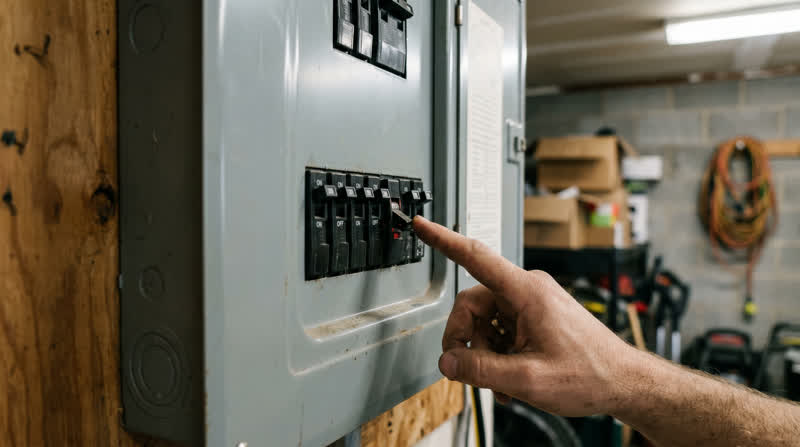
Your AC's outdoor condenser unit is powered by a dedicated double-pole breaker in your main electrical panel, typically rated at 30 to 60 amps depending on the system size. The indoor air handler usually runs on a separate 15 to 20 amp breaker. When the circuit draws more current than the breaker's rating, the breaker trips — this is intentional protection against overheating wires, damaged components, and fire.
A breaker that trips occasionally can be weak or at end of life. A breaker that trips consistently means the circuit is consistently drawing too much current — the breaker is doing its job correctly, and the problem is in the AC system or wiring.
Cause 1: Dirty Air Filter Causing Overwork
This is the easiest fix to check first. A severely clogged air filter forces the blower motor to work much harder to pull air through the restriction. Under sustained high load in Winter Haven's summer heat, the motor may draw current above its rated amperage, which trips the breaker. Replace the filter and see if the problem resolves. If the breaker still trips, the filter wasn't the only problem.
Cause 2: Failing Compressor Drawing Hard
A compressor that is aging, overheated, or failing internally can draw 2 to 3 times its rated amperage during startup — a condition called "hard starting." This current spike trips the breaker. The compressor may have been running fine for years before the startup draw increased enough to trip the breaker.
Hard-starting compressors can sometimes be helped with a "hard-start kit" — a capacitor and potential relay that reduces the startup current spike. This is a $100 to $300 repair that can extend a compressor's life. However, if the compressor internals are failing, hard-starting is a sign of impending complete failure and may indicate it's time to weigh repair versus replacement costs.
Cause 3: Refrigerant Leak Causing Overwork
A system running with low refrigerant works harder and longer to achieve cooling. The compressor operates under greater load with improper head pressure — conditions that cause it to draw higher amperage than normal. A refrigerant leak that causes a tripping breaker is a two-problem situation: the leak is causing inefficiency, and the resulting overwork is tripping the electrical protection. Both need to be addressed.
Cause 4: Electrical Short or Ground Fault
Wiring in the outdoor condenser unit is exposed to Florida's sun, rain, and heat cycling year after year. Over time, wire insulation can crack and allow bare copper to contact the metal cabinet (a ground fault) or another wire (a short circuit). Both conditions cause immediate and large current spikes that trip the breaker instantly — often before the system even fully starts.
Signs of an electrical short or ground fault:
- The breaker trips immediately when reset — within seconds
- A burning smell from the outdoor unit or disconnect box
- Visible scorch marks on wiring or components
- The breaker feels warm or hot when you touch it
This requires a licensed HVAC technician and possibly a licensed electrician to diagnose. Do not keep resetting a breaker that trips immediately — the short must be located and repaired first.
Cause 5: Failing Run Capacitor
The run capacitor keeps the compressor and fan motors running efficiently once they've started. A failing capacitor forces the motors to draw higher-than-rated running current, which can trip the breaker after the system has been running for 20 to 30 minutes rather than immediately. This pattern — system starts fine, runs for a while, then trips — often points to a weakening capacitor.
Capacitor replacement costs $150 to $350 and is one of the most common AC repairs in Winter Haven. Florida's heat is particularly hard on capacitors, which degrade faster at high temperatures. This is why technicians test capacitors on every maintenance visit — a capacitor showing low microfarad rating on a meter is days or weeks away from causing exactly this problem.
Cause 6: Weak or Failing Breaker
Breakers have a lifespan. A breaker that has tripped many times over the years can develop a lower trip point — it trips at a current draw below its rated amperage. If your AC has been well-maintained, the system hasn't changed, and the tripping is new, the breaker itself may be the culprit. A licensed electrician can test the breaker and replace it if needed. Breaker replacement costs $75 to $250 depending on panel type and access.
What to Do When Your AC Trips the Breaker
- Reset the breaker once — move it fully to the off position, then back to on
- If it stays on, check that the filter is clean and the outdoor unit fan is spinning
- If it trips again within minutes or immediately on reset, turn it off and call for service
- Do not attempt to bypass the breaker or install a higher-rated breaker as a fix
- If you smell burning or see scorch marks anywhere in the electrical system, leave the breaker off and call for service
Frequently Asked Questions
Can I reset the AC breaker myself?
Yes, you can reset a tripped breaker once to test whether it holds. Move the breaker handle fully to the OFF position first, then back to ON. If it holds for more than 30 minutes, monitor the system. If it trips again, call for service rather than continuing to reset. Multiple resets while the underlying problem persists risks compressor damage and fire hazards.
Why does my AC trip the breaker only on the hottest days?
High outdoor temperatures in Winter Haven push the compressor to work harder, drawing more current. A compressor that runs near its amperage limit on moderate days may exceed it on a 95-degree afternoon. A capacitor that's weakening may fail under peak load but hold on lighter days. Heat-related tripping that only happens on the hottest days is still a sign of a component that needs service before it fails completely.
How much does it cost to fix an AC that keeps tripping the breaker?
Cost depends on the cause. Capacitor replacement runs $150 to $350. A hard-start kit installation is $100 to $300. Refrigerant leak repair adds $350 to $700. Wiring repairs vary by scope. A breaker replacement by an electrician is $75 to $250. Top Notch Air Conditioning & Heating provides written estimates after diagnosis — call (863) 875-5500 to schedule.
Don't Keep Resetting a Tripping AC Breaker
A repeatedly tripping AC breaker is a warning you shouldn't ignore in Winter Haven's summer heat. The sooner the underlying cause is identified, the smaller the repair bill and the lower the risk of compressor failure or electrical damage. Top Notch Air Conditioning & Heating has diagnosed and repaired hundreds of breaker-tripping AC problems across Winter Haven and Polk County since 2012. Call us at (863) 875-5500 or schedule online for a same-day diagnostic.